
WELCOME TO THE BURGH BLOG
The Maryhill Burgh Halls blog offers a rich tapestry of stories, research, and reflections that celebrate the history, heritage, and community spirit of Maryhill, Glasgow. It features contributions from local historians, volunteers, and staff.
Scroll down to read and email info@mbht.org.uk if you would like to share something of your own.



Lest we forget
Words by John Thomson
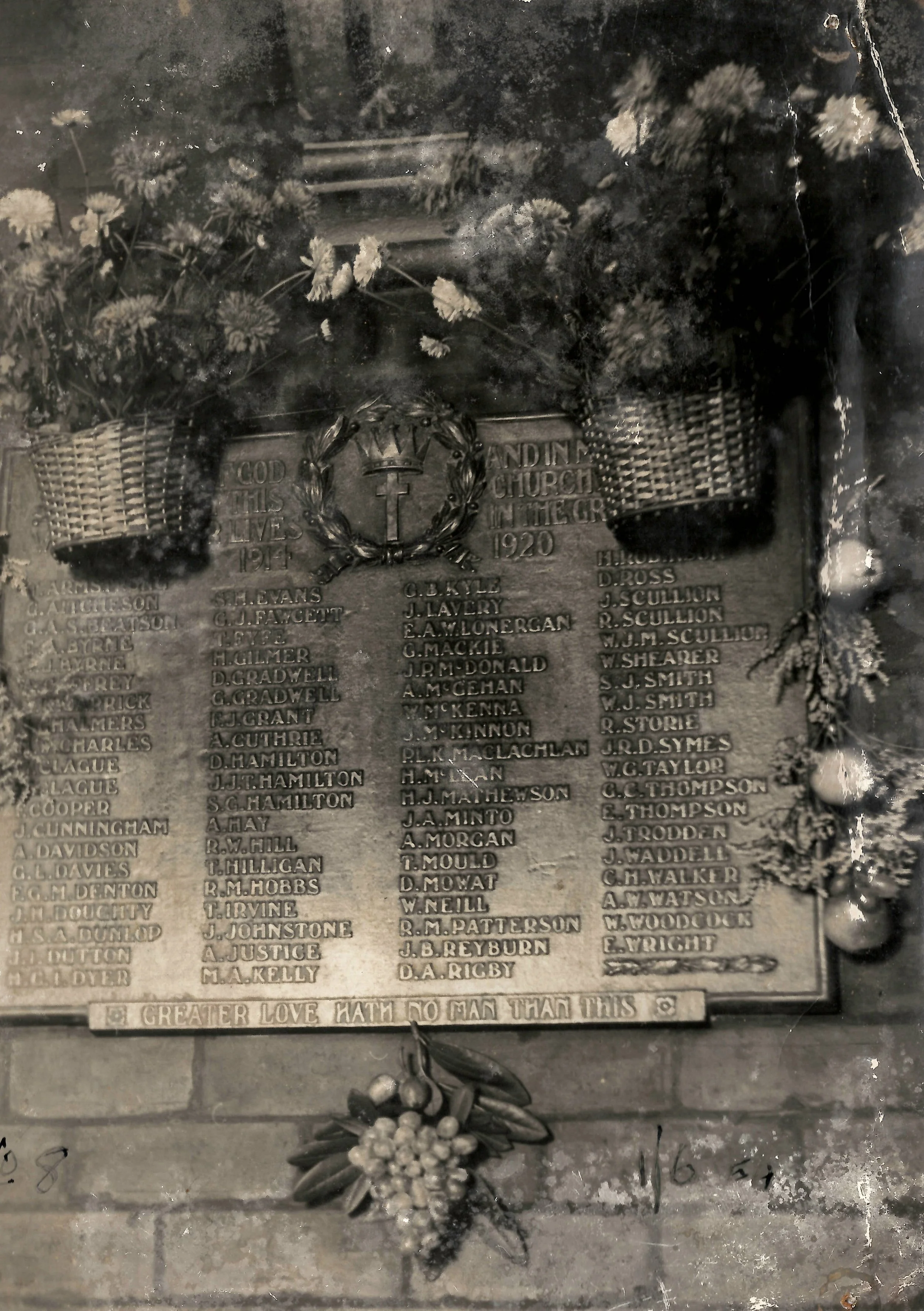
The plaque in its original location, on the walls of St George’s Episcopal Church. (Credits: Max McConville)
Earlier this year, on Friday, 25th April, at the appropriate time of 11 am, a bronze, memorial plaque commemorating 78 Maryhill men who died during World War I, was unveiled, here, at Maryhill Burgh Halls.
The ceremony to mark its return was attended by local community members, serving and veteran military personnel, and representatives from the 6th Battalion of the Royal Regiment of Scotland. It was a full and proper ceremony with a colour party, the laying of wreaths and an address from Paul Sweeney, MSP.
The plaque which was made in 1920 at a cost of £100, had originally been hung at St George’s Episcopal Church in Sandbank Street and dedicated in April 1921, but in subsequent years, it seemed to have disappeared. It was eventually found in the storeroom of the Royal Highland Fusiliers Museum in Glasgow, following extensive research by Adie Meehan, who came across it while tracing family history – Adie having family connections with Percy Lawrence McLachlan, his wife’s great uncle, one of the men listed on the plaque – but the men are also listed elsewhere. To mark the occasion, a commemorative booklet was produced, featuring short biographies of many of the fallen.
But that doesn’t have to be the end of it.
We, at the Halls continue to seek additional information, photographs, and stories from family members and descendants. Please contact heritage@mbht.org.uk to share.
But the ceremony reminded some of those attending of another, missing, memorial and the story of some other lost men of Maryhill – the 211 men of the now demolished Lyon Street in Maryhill who emerged from a half dozen closes in that street and went on to enlist in almost every Scottish regiment that fought in the First World War.
A Roll of Honour was created for them as well. It gave the bare details of the men who had enlisted, including sixteen names of men who never came back, twenty-seven who were wounded and two who were ‘simply’ marked missing on the roll.
This roll, apparently, hung in a local pub - the Garscube Bar - until it was demolished in 1962, as was Lyon Street, and the roll vanished.
Various attempts to locate it were made, including a project involving Oakgrove and St Joseph’s RC primary schools, but its whereabouts remain a mystery and any information regarding its location would be much appreciated.

The plaque at the rededication ceremony.
The plaque we do know about, remembering the 78 men, is on permanent display in the Halls on the mezzanine floor on a wooden plinth which was created by Boomerang Woodworking CIC. The names represent real people – sons, fathers, brothers and neighbours – who lived in and around Maryhill, before heading off to war, never to return.
They shall grow not old, as we that are left grow old;
Age shall not weary them, nor the years condemn.
At the going down of the sun and in the morning
We will remember them.
- The fourth verse of ‘For the Fallen’ by Robert Laurence Binyon (1914)
Artist highlight: Hilda Goldwag
Words by Alyssa Mills
October (1962) via East Dumbartonshire Council
In a time of renewed focus on questions of culture and identity in Britain and Scotland, it is vital to recognise the outstanding contributions of immigrant and refugee artists, such as Hilda Goldwag. Looking at Goldwag’s charming, lived-in tenements or idyllic landscapes on the banks of the Clyde, it is clear with every brushstroke the love Goldwag had for her adoptive city. Goldwag takes a different approach to her contemporaries, neither highlighting the poverty and social unrest which accompanied Glasgow’s industrial decline nor neglecting its reality in favour of a glamourised portrait of the city.
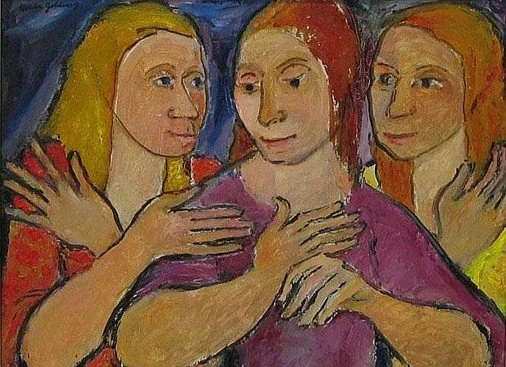
Conversation via Clare Henry Art Journal
Having trained in painting as a young girl in Vienna, Goldwag was influenced by the less traditional compositions and colours being forwarded by European expressionists, especially the German-led Die Brücke style. While an increasingly abstract style was gaining prominence in British art, Norbert Lynton (1994) describes Die Brücke as uniquely bright in colour and ‘assertively primitive’ in form, with ‘at first sight no sign in their work of direct social comment or even of personal anxieties.’ Both Goldwag’s figures and landscapes feel nostalgic and honest - a realistic depiction of the world through the lens of someone who cares deeply about their subject. But to say Goldwag’s art is apolitical is inaccurate. Her comforting, domestic scenes are defiant in their affection, creating a theme through over 60 years of painting. Her work is intimate and optimistic, a lens through which the oft-dilapidated canals and streets of Glasgow are transformed into a vibrant cityscape which feels instantly familiar to those who love Glasgow like Hilda.
Early Life

Blinds via McTear’s
Hilda Goldwag was born in Vienna, Austria, in 1912, and trained as an artist against the backdrop of the growing Nazi regime. Only a year after graduating with a degree in graphic arts, Hilda had to leave her home and family for the safety of the UK, moving to Edinburgh and shortly later, Glasgow as a refugee. Her family, expected to follow six months later, were approved to travel the day WWII broke out, leaving them stranded in Austria. Goldwag’s mother, brother, sister, brother-in-law, and young nephew were eventually killed. This grief is recurrent in Goldwag’s work, as is the sudden isolation she experienced as the sole surviving member of her family, alone in an entirely new and unfamiliar country. Her painting Blinds evokes the unnerving mixture of fear and curiosity she must have been feeling in her early years living in the UK.
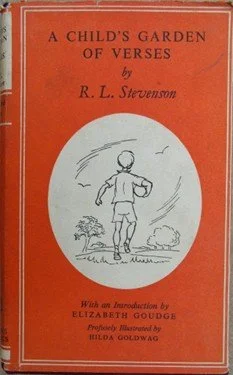
Despite not pursuing her art full-time until retirement, Goldwag quickly moved from domestic help for a Church of Scotland minister to Head of Design for a Glasgow printworks, primarily designing scarves for Marks and Spencer's and working as a freelance illustrator for children's books, cards, and magazine. She also enrolled in life drawing classes at the Glasgow School of Art in 1945. Perhaps her most widely distributed work is the original illustrations for Robert Louis Stevenson’s A Child’s Garden of Verses (1955) for Harper Collins.
Making A Life
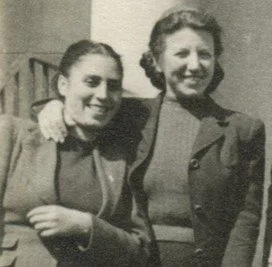
Cecile Schwarzchild (left) and Hilda Goldwag (right) in the 1940s
via Scottish Jewish Archives Centre
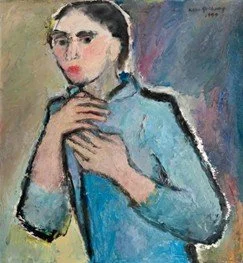
Cecile Schwarzschild (1915–1998) via Scottish Jewish Archives Centre
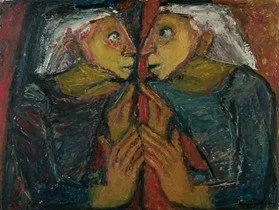
Mirror Image via McTear’s
Shortly after Hilda’s initial move to the UK, she met fellow refugee Cacilie Zoe Schwartzchild, or Cecile, in a Quaker meeting house in Edinburgh. The two became quick and enduring friends, and did war work alongside each other at McGlashan Engineering Works in Glasgow. The two remained close for decades until Cecile’s death in 1998. Even before she began painting full-time, Hilda painted her lifelong companion many times from life and from memory. The portrait above was painted shortly after Cecile’s death, depicting her young, as Hilda may have met her. Even where Cecile isn’t explicitly the subject of Goldwag’s art, the relationship between these two women lingers in her many figure paintings of couples - young and old; familial, platonic, and romantic - who appear to comfort each through a terrifying and uncertain post-war world. Both women were torn away from beloved family by the Holocaust and lived in a world defined by grief. The importance of this companionship to Goldwag’s life and work cannot be overstated. Hilda’s work in the years after Cecile’s death speak to an enduring loneliness which is echoed in the myriad forms of grief experienced by its audience
Depicting Glasgow

Artist Assessing Her Work 18-07-90 by David Holgate
While Hilda worked primarily in creative and design work post-war, she continued painting as a passion, usually using oil paints and a palette knife on board, as canvas was prohibitively expensive. From the 1950s until her death in 2008, Hilda would pile her supplies into a shopping cart and cross the city and especially Maryhill on city buses, leaving her completed paintings to dry on the luggage racks. She completed dozens of paintings in this period utilizing her distinct and evocative expressionist style to represent Glasgow’s crumbling tenements criss-crossed by washing lines, the declining industrial technology overtaken by the city’s great green places on the banks of the canal, and, with the same brush, the weary but determined people of Glasgow. While avoiding explicit or heavy-handed political imagery, Goldwag nonetheless leverages dynamic posing and framing, bold colours, and complex shape language to bring to life the everyday dichotomy a city that was post-war and post-industrial, and yet on the verge of a cultural revival. These domestic scenes are honest and familiar, such as Springtime Courting Scene, which is immediately familiar to the thousands of Glaswegians who visit its many parks every day for a picnic or to soak up brief rays of sunlight between rainstorms.

Springtime Courting Scene
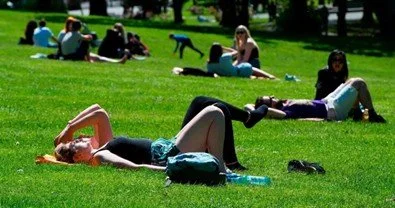
via Glasgow Life
If one thing is clear to the viewer of Goldwag’s paintings, it's a deep and enduring love for her adoptive city. Her landscapes are broad in subject, depicting the Forth and Clyde Canal and the tenements and factories on its banks, flowers, farms, waterfalls, rivers, and more. In regard to Goldwag’s landscapes, artist Alexander Moffat claims 'her intimate glimpses of canal sides, snow covered streets, trees in blossom, suggest an optimistic view of urban life'.

Broken Fence via McTear’s
As a Glasgow transplant myself, the lens through which Hilda Goldwag depicts her home is intimately relatable. Her imagery is honest, never over-glorifying and neither highlighting the symptoms of industrial decline and poverty which is and was ever-present in the city. The crooked churches and winding canals are the heart of a city built by and for its workers, many of whom are, like Hilda, refugees and immigrants. Even where figures are absent from the painting, her landscapes are lived in. One example is Broken Fence, which depicts a fence twisted and rent by a violent storm. The composition and colour are dynamic, and the lighting is low enough to disorient the viewer before the image comes into focus. The painting is chaotic and disorienting, giving the viewer the feeling of being outside during a heavy storm, wind whipping about. These works are whimsical and heartfelt without leaning towards the absurd; and represents a very conflicted time for Glasgow’s identity with nuance and hope.
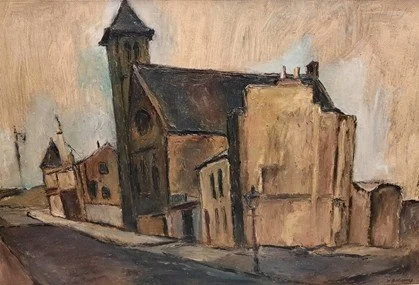
Church on Maitland Street via East Dunbartonshire Council
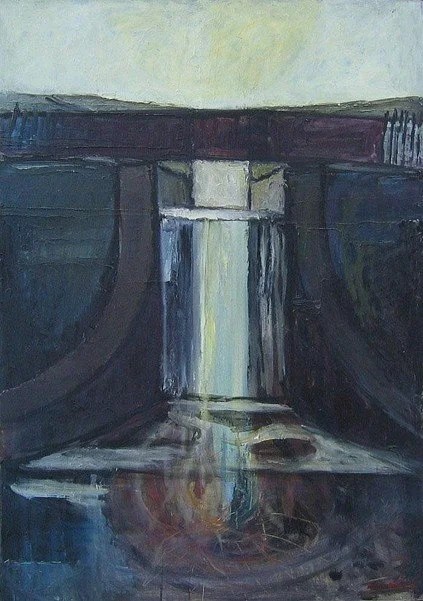
Dam Overspill on display in Maryhill Burgh Halls
With protests against immigrants and refugees taking place across the UK, it is more essential than ever to recognize that there are few who love and contribute to the UK more than its immigrants and refugees. The idea of ‘protecting British culture’, often invoked in debates about immigration and identity, too often overlooks the invaluable contributions of the many immigrant-led communities and subcultures that have shaped the nations. Artists, engineers, politicians, craftspeople, writers, and labourers across the country have contributed to the complex tapestry of the culture we live in. Hilda Goldwag gave up everything for a chance to build a life free from oppression, including, unfortunately, her family. Hilda Goldwag is one of few Glaswegian artists whose work primarily depicts the city itself, and more than that, Hilda herself is a part of the fabric of the city. By painting in situ, and in so many locations throughout the city, Goldwag’s process was as much art as her finished work, and her and her shopping cart loaded with paintings and supplies became a familiar sight to Glasgow’s residents. Looking through a collection of Goldwag’s paintings serves as sort of tour of the city, preserving a tumultuous period of its history in work that speaks to both to its reality and its underlying spirit.
In her lifetime, Hilda Goldwag received modest recognition but was never considered a renowned artist. She exhibited her work in Gourock, Greenock and at the Lillie Art Gallery in Milngavie; received awards from the Glasgow Society of Women Artists; and was a professional and exhibiting member of the Scottish Society of Women Artists, the Paisley Art Club and the Milngavie Art Club. It is impossible to question Hilda’s talent, but one must wonder her intention when creating art. Her style, which so tenderly depicts friends and strangers alongside tenements and canal scenes, each viewed through an eye which finds beauty because of, and not in spite of, its flaws, speaks to an artist who has found comfort and community amid impossible circumstances. In times like these, when the world seems to be falling apart, there is a quiet resilience in seeking out the beauty of our local space and working to make it better. Hilda Goldwag, and countless refugees and immigrants like her, have made essential contributions to the towns and cities they call home, and it is vital that their current and future place in Scottish culture is fiercely protected.
You can see Dam Overspill here in Maryhill Burgh Halls.
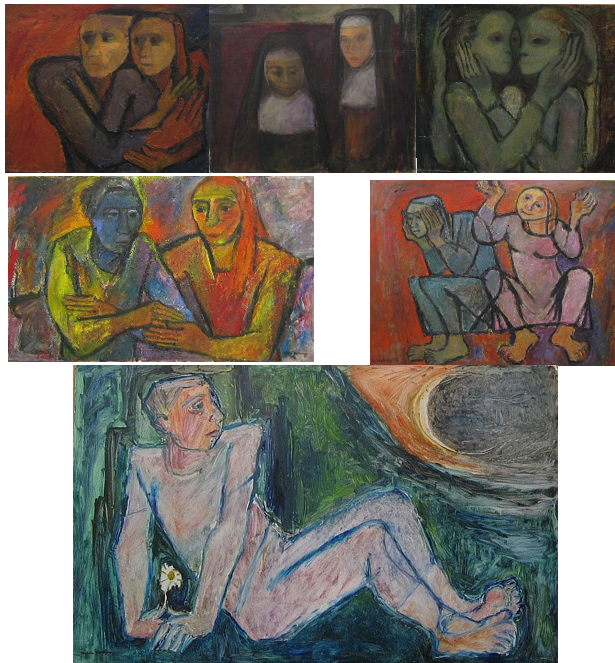
Explore some of the rest of Hilda’s work below, with paintings chosen to emphasise the breadth of style and subject which Hilda lent her considerable skill and unique perspective to bring to life. All paintings featured here are found at Invaluable Auctions site.
In order, paintings are as follows. Portrait Study of a Woman, Old Woman, Schoolgirl on the Beam, Shadow, Nightmare, Man Helping Man, Old Man with Daughter, Icy Crags, Ripple, Woman in Shades of Blue, Dance, Two Faces, Two Nuns, Twin Heads, Women, Contemplating the Moon, and The Guide.

Maryhill – a look back to looking ahead
Words by John Thomson
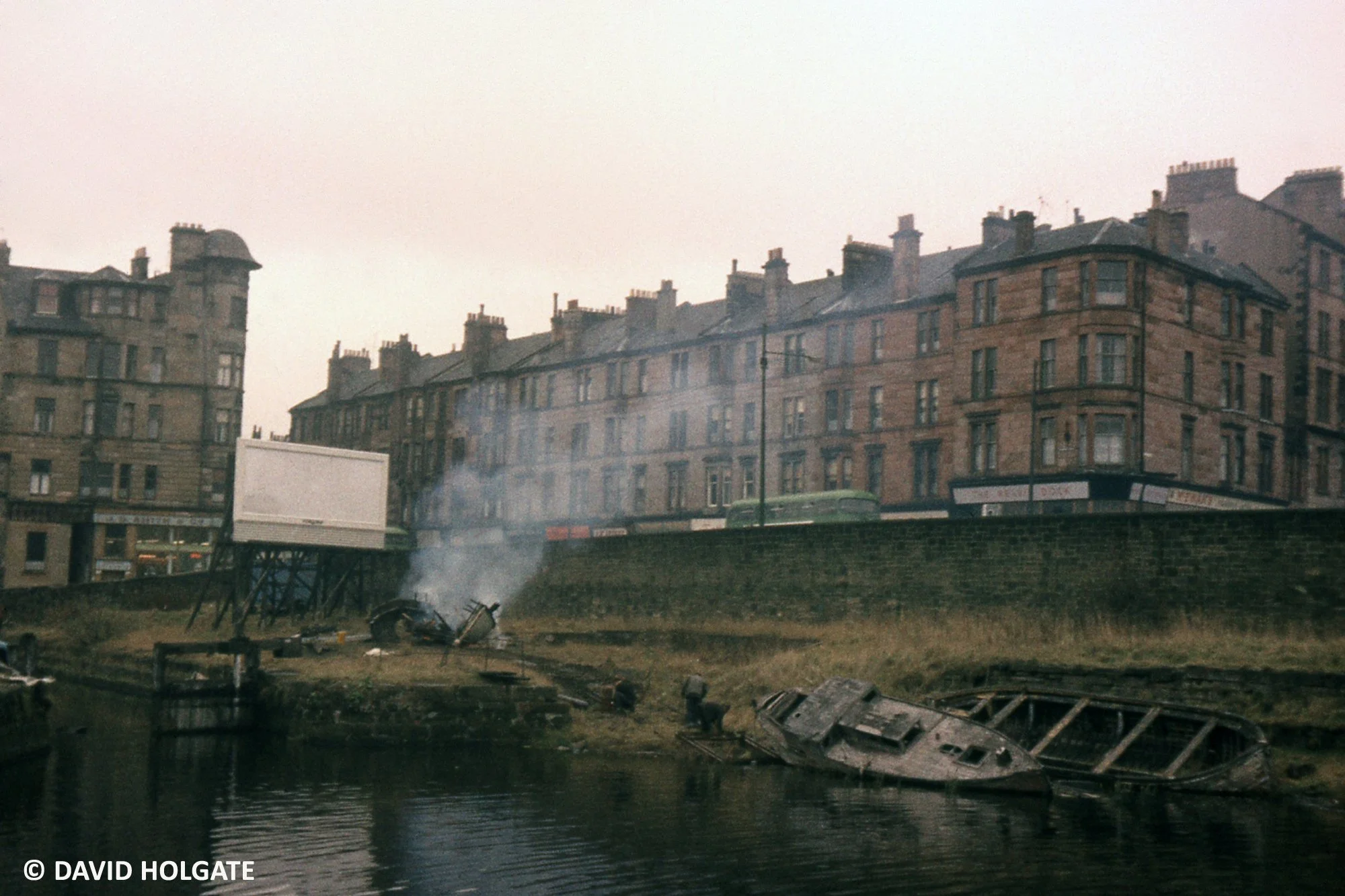
Kelvindock in December 1967 by David Holgate (Drumchapel Camera Club)
In 1978, a young American lady from Missouri, according to the Evening Times, was given ‘the task of rebuilding Maryhill’ which was a journalist’s way of explaining that Marilyn Higgins was a Glasgow District Council Planning Officer charged with implementing the Maryhill Local Plan, the biggest of its kind in Scotland.
Marilyn went on to say that ‘Maryhill and Missouri may be different, but Maryhill has so much character and personality I think it's going to be quite something.’
Aye. Right.
Mind you, it’s not the first time that Maryhill’s future, and indeed, its past, have been discussed in the press and it would be interesting to know what some of those writers would think of Maryhill today. A random trawl through the newspapers of fairly recent times can reveal a lot.
In 1968 C(harles) A. Mckean, who went on to become a prominent architectural historian, described Maryhill as a village where ‘the beautiful and romantic Kelvin is overgrown with weeds and surrounded by rubbish………The canal is concealed behind walks and hoardings, and the view over to the hills is obscured by dingy street lights and disfigured by waste and derelict ground.’
The answer was simple.
‘The canal (should) be put to good use and its banks cleared of the corrugated iron shacks, walls and hoardings. The canal is there to be seen, not to be hidden, for it has the most beautiful situation.’
His concern was that the canal was to be destroyed, given up to yet another motorway scheme trampling its way through the Glasgow streets.
The Glasgow journalist and bon vivant, Jack House, was another one to extol the virtues of the canal but particularly where the aqueduct carries the canal over the River Kelvin, described by some (in Maryhill) as the Eighth Wonder of the World and by others as
‘the beautiful and romantic situation of the aqueduct carrying a great artificial river over a deep valley 400ft in length, where square-rigged vessels are sometimes seen navigating at the height of 70ft above the heads of spectators, affords such a striking industry as pleases every spectator and gives it a pre-eminence over everything of a similar nature in the kingdom.’
And do you know what? Their dreams came true.
The revitalised Kelvin Walkway links Glasgow city centre with Milngavie and from there to the West Highland Way.
The canal was cleared and re-emerged as more than just a much used waterway between the East and West coasts of Scotland. There’s an art park on the ‘other side’ of the canal featuring Bella the Beithir, a 120-metre-long momentous sculpture situated next to the new Stockingfield Bridge, commissioned by Scottish Canals and a major source of interest to locals and visitors alike.
Further down the canal, on the way into town and the reinvigorated Speirs Wharf, is Hamiltonhill Claypits Local Nature Reserve, the biggest inner-city parkland in Glasgow with a superb view over the whole of Glasgow and an amazing range of wildlife from deer to bumble bees – not bad for a disused quarry and old and decrepit wasteland which is now a thriving community reserve.
But there’s more so much more in these press cuttings than the green, green grass of Maryhill.
In 1986, as highlighted in the Evening Times, the locals of Maryhill took on the might of the, then, Scottish Office and Strathclyde Regional Council in order to save a wall – but this was no ordinary wall. This was the wall surrounding the Wyndford housing estate in Maryhill – formerly a huge army barracks where Rudolf Hess, a deputy of Adolf Hitler, was briefly detained during World War II in his unsuccessful bid for peace. The Community Council saw it as an ‘important piece of local history that ought to be preserved.’ And not only did they save the wall, but they also saved the barracks’ guard house and the bollards offering protection from the Maryhill Road. There are some photos of the wall on the mezzanine floor of Maryhill Burgh Halls.
Ah, yes, the Halls.
Built in 1878, and designed by the distinguished architect, Duncan McNaughton, they had been allowed to fall into wrack and ruin but in 1981, the Evening Times described the fight of Maryhill Burgh Community Centre Trust (sic) to buy the Halls for £100 in order to rebuild them.
They were successful but, according to the Times, they still had to find £500,000 to combat dry rot and pay for the much needed restoration. That was to be in the future and there were many hills to climb before the actual Halls re-building and refurbishment by the current Maryhill Burgh Halls Trust was to begin.
This wasn’t until 2009 and by then, it had become a £9.2 million restoration project but a very successful one. It offers office accommodation for rental, as well as recording studios and a private nursery. It also provides excellent exhibition space for a whole range of exhibitions and currently has a major tenant in the Maryhill Hub, which, in itself, provides a wide range of activities for the area, following its need to move from the redeveloped Wyndford housing scheme.
So much of this story, about the Kelvin and the Canal and the buildings in the area, are available from the Halls in the guise of a range of well written and well illustrated walking guides to the area available from the Halls’ Reception.
But, yes, built in 1878, so that must mean that in 2028, the Halls will celebrate their 150th Anniversary. So, what does the future hold for the building?
The Evening Times got it right all those years ago.
‘It is a fine old building. As a community centre it would give the new Maryhill a heart. All power and support to the people who have taken on such a tough but worthwhile task.’
What do you imagine Maryhill’s future to be?
We would like to thank Richard Ward for generously sharing newspaper clippings that supported our research.
The Smuggler’s Stone: Whisky, Violence, and Justice in 19th-Century Maryhill
Words by William B. Black
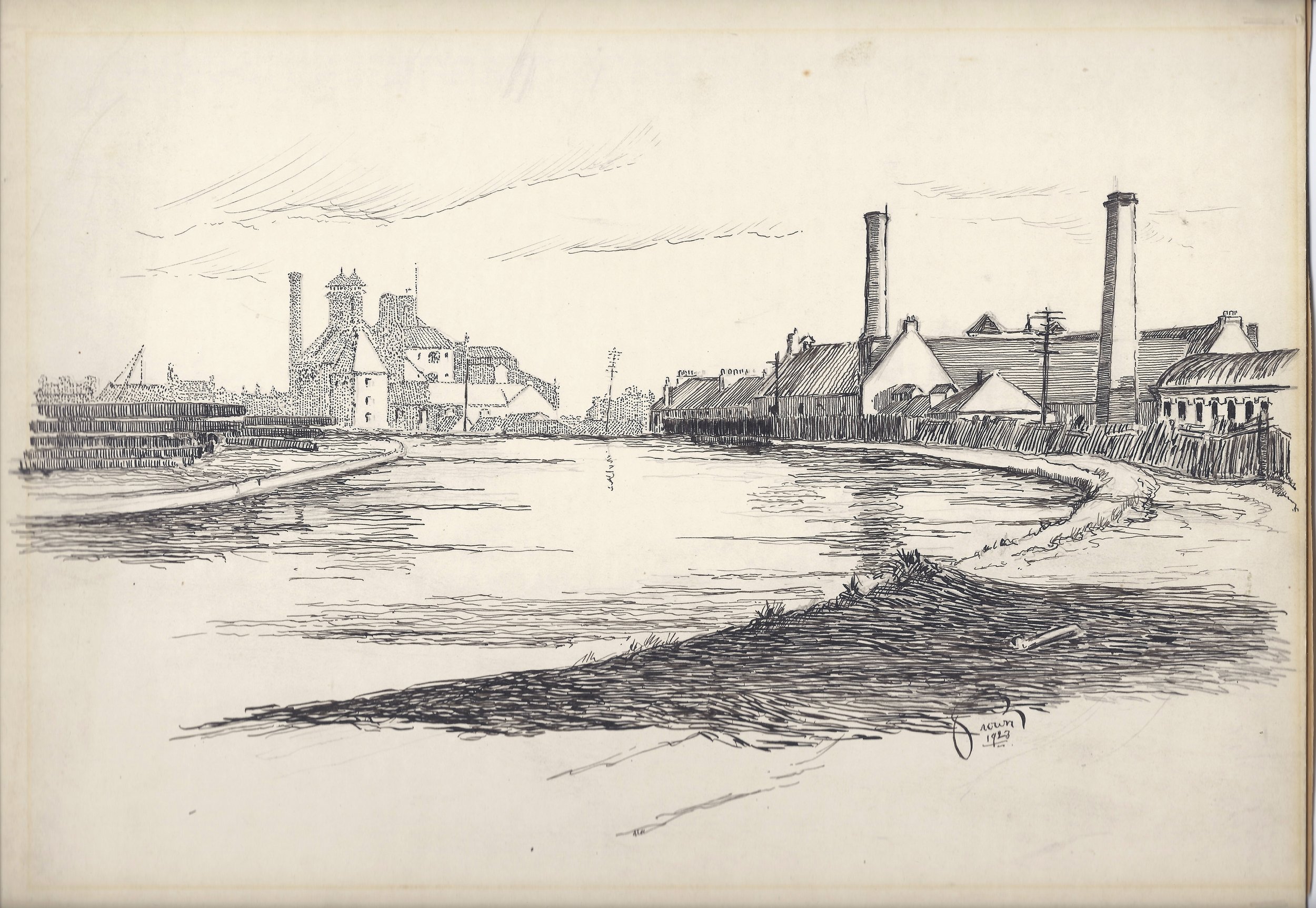
Sketch of the canal between the Old Basin and Firhill Basin, 1920 - Maryhill Burgh Halls Collection
In his memoir of Maryhill, Random Notes & Rambling Recollections, Alexander Thomson mentions the
‘Smuggler’s Stone.’ Apparently it stood on the canal side of Maryhill Road, almost opposite Braeside Street, but was lost to view when the canal company erected a fence around 1870. As no trace remains today it must have been removed around the same time.
At the beginning of the 19th century, whisky smuggling was an expanding business in the West of Scotland, partly due to the high rate of duty imposed on the lowland districts. The produce of illicit stills along the margins of the highlands found a ready market in the Glasgow area and the toll road from Drymen, which ran through Maryhill was a route used frequently by the smugglers. Among those was a gang known to be operating from Aberfoyle, including in its number Duncan McFarlane, the carrier from Gartmore. At the beginning of April 1813, James Anderson, a customs supervisor, had intercepted eight of them at Canniesburn Toll, all of whom were seen to have tin containers strapped to their backs. It was known that this was the normal mode of transport and that each container could carry five gallons of spirit, around twenty-three litres. Unfortunately the gang was on the return journey to Aberfoyle and the containers were empty, preventing the excise officers from taking action. However, as the smugglers passed, they showed that they were armed with stout cudgels (a short, thick stick used as a weapon) and made serious threats at the excise men. That this was no idle threat had been shown on 16th March after excise officers captured whisky near Bishopbriggs. As they returned to their base at Port Dundas they were attacked by four armed men, who recovered the whisky. In this attack, one of the customs officers, Quintin Dick, had been stabbed three times.
During the month, intelligence was received that the Aberfoyle gang were to make another run and plans were made to ambush them. After dark, on Thursday 29th April, eight excise officers left Port Dundas, including Dick, who had recovered from his wounds sufficiently to be on duty. All of this party was armed, at least two carrying stuff sticks, stout wooden sticks within which was concealed a removable spike with a sharpened tip. Officially, they were used to probe suspicious parcels but would provide a useful defence against armed smugglers. In addition, three of the party carried pistols, although the usual customs weapon, the cutlass (a short sabre), was not provided, although this was usual when armed resistance was expected.
It was known that many in the local population were sympathetic to the smugglers, so to avoid detection they came along the canal towpath until they had passed Firhill Bridge. As the canal continued towards Ruchill Bridge it came within 30 ft (9 metres) of the Toll Rd (Maryhill Road), where it was about 10.5 ft (3.5 m) lower than the towpath. On the opposite side of the road, the ground rose steeply on a hill known as Sheepmount to a height of 41 ft (12.5 m) above the road, with no other obvious escape route. Today this ambush point is above Braeside Street, where the road curves towards Kelvinside Avenue. In 1813, there were no houses on this stretch, the closest being the lodge for Kelvinside Estate, which stood at the top of what became Kelvinside Avenue, while on the opposite side of the road was Kelvinside Cottage.

Ambush site - from NB 1859 OS Map, most houses shown did not exist in 1813
The ambush party was on site just after Midnight, concealing themselves on the Sheepmount side of the road and, after an hour and twenty minutes, they heard a party of people coming from the Maryhill direction.
The night was very dark and the smuggling party spread out, probably as a precaution against all being caught by an ambush. As the first group passed, the excise officers jumped out onto the road and ordered them to drop their burdens but, in the excitement, failed to identify themselves as excise officers. However, later, most of the smugglers, of whom there were eight, admitted that they did not doubt the identity of their assailants. In the initial attack, the unfortunate Dick was struck on the head by a cudgel and fell to the ground dazed. Initially, the excise officers were able to push the smugglers across the road but, as the fight developed, they were forced to retreat back to the Sheepmount side.
At one point, another of the excise officers William McDowall, was struck on the head by a cudgel and fell to the ground. Although he suffered a serious cut, he was wearing both a hat and a nightcap, this improvised protection saving him from ore serious injury or death. Suddenly, a shot rang out and one of the smugglers, Malcolm McGregor, shouted out to McFarlane, who was near him ‘Duncan! I’m gone!’ Unlike the other smugglers, McGregor was a labourer from Anderston but may have had relations in the Aberfoyle area. He had been struck in the left thigh and McFarlane pulled him over the wall bordering the road and into the trees, to conceal the wounded man from their opponents. Another of the smugglers, Peter McAlpine, had been knocked into the roadside ditch during the initial scuffle and, as he lay there, the excise officers rallied once more, forcing the remaining smugglers to flee back towards Maryhill.
Other than the officers mentioned, Nathaniel Ingram, Campbell Gardner and Neil Buchanan had also received injuries during the fight, but none was serious. Although they had driven off the smugglers, past experience suggested they might return with reinforcements, so the priority was to confiscate the whisky. By the time the officers began to gather the flasks, McFarlane and McAlpine had emerged from hiding and managed to recover two of them before following their companions away from the scene. Thus six flasks were picked up by the excise officers, who returned to Port Dundas once more along the canal towpath. As they did so it was established that three shots had been fired, one each from McDowall, Hugh Chalmers and William Kelly, although none could confirm having hit anyone. As the smugglers gathered together once more, they discovered that William McFarlane and Duncan Graham had been wounded, while Graham’s brother George and McGregor were missing. Both men were found lying behind the wall where Duncan McFarlane had left McGregor. The former was able to walk but it was obvious Graham was seriously wounded. A contact named Ferguson lived nearby, so they obtained a large sheet from him and used it to carry Graham back to the house, where it became obvious that both he and William McFarlane required medical assistance. Around 6am that morning, several of the smugglers appeared at the Royal Infirmary, where the wounded men were examined by two surgeons, George McLeod and James Watson. Graham had died by this time, while McFarlane was in poor condition, having his left arm and leg amputated. McGregor was examined by a third surgeon, William Penman, who removed a pistol ball from his thigh.
Although the Glasgow Herald had reported the matter was under investigation, it is probable most considered there would be no further action. Therefore it was surprising to find Chalmers, Ingram, Gardner, McDowall and Kelly all standing in the dock at the High Court in Edinburgh on Monday 14th June. While in hospital, Duncan Graham and William McFarlane had made two ‘dying declarations,’ although subsequently they did recover. Both remained in hospital by the time that the trial began and the Solicitor General, Henry Home Drummond, who was leading the prosecution, intimated that he would not use the declarations as evidence. However, knowing the smugglers remained in capacitated, one of the defence advocates, John Clerk, insisted they should be included, as they contained admissions that the smugglers had started the fight. Thinking that the two men would be unable to attend for some time and it was probable they would retract their statements in the interim, Clerk declined Drummond’s offer to have the trial delayed. Unfortunately for Clerk, the trial judge, Lord Boyle, the Lord Justice Clerk, had learned the men would be fit within a few days, so refused to allow the declarations to be included as he understood the men would be able to testify in person.
Dick was the first witness, stating that one of the smugglers had laid down his flask slowly when challenged but, as he moved forward to retrieve it, he was struck by the cudgel and stunned. He had been armed with a stuff stick but claimed he had not drawn it and used it only to fend off further blows. As he recovered, he had become engaged with another smuggler and, as they struggled, saw McDowall pull back from the man he was attacking and fire his pistol. At this point, Dick felt McDowall was having the worst of the struggle but, following the shot, he saw the smuggler run off. Another of the excise officers, Alexander Mudie confirmed that the smuggler he had tackled had laid down his flask and initially stood quietly. Then, as Dick was struck, the man took the opportunity to flee and, according to the excise officer he was not involved further in the fight, although his colleagues were hard pressed at one point. Another excise officer, Buchanan, confirmed that all but Ingram had been armed with stuff sticks, referring to the Bishopbriggs incident among others where it was known smuggling gangs had been armed and prepared to resist.
Although the declarations admitted the men had been involved in smuggling, none of them had been charged with any offence following this incident. Five of them gave evidence, Duncan McFarlane, McAlpine, McGregor, Samuel Cameron and Robert McLaren. All of them told identical stories, claiming that they had laid down the flasks when demanded and, although armed, used the cudgels only to fend off the blows of the aggressive excise officers. As each of the smugglers repeated the same story they drew a sarcastic comment from the Judge. He could not consider it true that ‘eight Scotchmen (sic) with sticks in their hands, would remain for five or ten minutes to being cut and slashed at, without ever striking a blow.’ When McLaren was asked whether the excise men could have seized the whisky without being armed, the Solicitor General tried to object to the question. However the judge over-ruled him and the witness was forced to admit they could not.
After hearing evidence from the surgeons who treated the victims, plus depositions by the accused, the court rose for the day. The jury contemplated their verdict all of the following morning before declaring the case against the excise officers ‘Not Proven’ at 1pm. Later it was learned that this verdict had been reached only by one vote, seven of the jury considering them guilty of culpable homicide. Before releasing them, Lord Boyle told the officers he considered the verdict correct but he had some comments to make. They were fortunate to have escaped punishment, both for failing to identify themselves and from refraining to use minimal force. Therefore, he warned them to be more prudent in future when faced with similar situations.
Although there were no further incidents recorded in the Maryhill area, the whisky smuggling trade continued to prosper until 1822, when greater powers were given to excise officers, followed in the next year by the Excise Act, which revolutionised the trade. Due to this the bottom fell out of the smuggling trade and the introduction of the legitimate whisky industry that exists in Scotland today. There is no record of when the cairn was erected at the side of Maryhill Rd, or by whom, although probably it was a spontaneous gesture by supporters of the smugglers. In the same manner that people with little or no connection see the need to leave flowers etc. at the site of modern tragedies, it is probable that local people and travellers from the Aberfoyle area had similar motivation.
While throughout the 19th century most Maryhill people knew about the smuggler’s stone, it appears that the details of the story were lost quite quickly and imagination allowed to roam freely. In consequence the following poem was published, probably around 1905, although the publication is unknown, having been discovered in a scrapbook in the Mitchell Library :
The Ghost of Kelvinside
There’s many a story you’ve heard me tell
How this and that and the other befell
But never, I’ve told of the awful ride Of the terrible ghost of Kelvinside
It was late at night as slone I sat
In my room in a cosy first floor flat
While I puffed my pipe the fire burned low
With hollows of crimson and purple glow
All was silent, and never a light
From the neighbouring windows around shone bright
Save the street lamp’s glimmer, which showed the way
Shining and wet ‘neath its flickering ray
For a storm of sleet, like a spectre bride
Whirled round my dwelling in Kelvinside
At two o’ clock, neither less nor more#
Came a muffled knock on my outer door
Who could it be at the hour of two
None could I think of, no one I knew
Would call me up at an hour so late
Unless his trouble and need were great
But I went and listened, then open’d wide The door to the Ghost of Kelvinside
My nerves were alert, my arm was strong
And I thought to myself “My friend you’re wrong if you think you’ll stagger a man like me”
So silent I waited that I might see
How the visitor, tall and weird, would deal
With a fellow whose nerves were “true as steel”
But the visitor bore himself with pride
And entered my house in Kelvinside
“Stop! Stop!” I exclaimed and upraised my hand But the figure advanced and would not stand
I barr’d his coming, but through my arm
He strode in a way that caused alarm
Limp, to my side, fell the outstretched limb
And the sight of my eyes grew dazed and dim
The fall of his feet never rais’d a sound
As he flitted from room to room around
Appalled I followed, and cold dead air
Was wafted about me as here and there
He paused, in apparent fruitless quest
In ancient habiliments quaintly derest
He knelt near a closet with ear to floor
And, I thought I detected a distant roar
Of voices like troopers in hot pursuit
Of a fugitive flying. The Ghost knelt mute
But over his visage a dark scowl came
And his sunken eyeballs seem’d darting flame
Then he rush’d to and open’d a window wide
And leapt to the roadway in Kelvinside
A phantom charger, awaiting him, paw’d
The gravel outspread o’er the roadway broad
But never a sound from the stamp of hoof
Caus’d echo from window, or wall, or roof
The champing of bit and rattle of chin
Should have sounded clear thro’ the driving rain
But naught was heard, tho’ a neigh seem’d to come
From the throat of the steed – but the steed was dumb
A vault to the back of the prancing steed
And off went the rider at lightning speed
But never the clatter of hoof on stone
Gave an indication of flesh and bone
A tremulous trail of a glimmering blue
Was left by the rider as on he flew
At times they leapt, as if obstacle lay
At places where nothing now bars the way
Then a shot rang out, and the rider and horse Fell prone to the earth – the rider a corse
I crept to my couch and hoped I might sleep I long’d for oblivion, clam and deep
With head under blankets, I strove in vain
To banish the spectre and slumber again
At length, with the dawn of daylight, I slept
Exhausted, and slumber my tired eyes kept
Haggard, unshaven, and bloodshot of eye
Was my morning look, and I don’t deny
I was rallied and “chaffed” by friends, in joke
On my way to the town, but no word I spoke
To al old time servant at once I went
And asked her to tell what the phantom meant
She told me the story, she’d heard when young Of a smuggler bold – who expir’d unhung – Shot where the passage from Forth to the Clyde
Winds near the old Sheepmount on Kelvinside
By the Aberfoyle clachan, from north he hied
With spirits for skippers who sailed from the Clyde
This story I’d heard from her as a child Just clear of the manor of Kelvinside
And I know that his ghost still fitful frets
O’er scenes of his sins (which it ne’er forgets)
For never a prayer o’er his shallow grave
Was uttered to hope his spirit to save
You will find old people in Maryhill
Remember the smuggler story still
But only a few of the oldest tell
The legend my nurse remembers well
“Go visit his grave,” she said to me
“and say the word’sleep’ – say it three times three”
So I did as bidden, beneath a shed
Which covers the spot where the man fell dead
And I hope that when next abroad he may ride
He won’t “call” at my dwelling in Kelvinside
-MONK BRETTON-
The author of this essay is a retired training manager who carries out research into less well known areas of local history in Glasgow and the West of Scotland. As a Maryhill native he has a particular interest in the history of the area and, especially, that of the old police burgh up until 1891. These essays are taken from the research notes that have been drawn up over a period of years and are intended as an introduction which can be used by those seeking more information.
Maryhill Burgh Halls Trust want to thank William Black for his incredible support throughout the years, having shared all his in-depth research and snippets since the start of the Trust’s journey into the history of the Burgh. We are also very grateful for allowing us to post his wonderful essays to our blog.
‘Hi there. Can I help you?’
Words by a volunteer
These are often the first words uttered by a volunteer when someone passes through the main doors of Maryhill Burgh Halls and until you get an answer, you have no idea what they’re looking for.
It could be someone looking for the offices of one of the tenants without realising that there’s a buzzer system and it’s your job to go outside with them and select the right buzzer; OR
It could be someone looking to view the latest exhibition – be it the gallus Glasgow suffragette Jessie Stephen or photos of Maryhill from fifty years ago – and it’s up to you to show them where the exhibition is, point out a couple of things and then stand back and let them do the talking. It’s amazing what you’ll learn; OR
It could be a wee girl in for the regular music lessons with her granddad and he’s given her some money to spend in the well stocked shop - buttons and bows can be a girl’s best friend; OR
It could be someone who’s not been in the Halls for many years – or maybe never at all – who are amazed at how the modern offices and recording studios exist in tune with the refurbished main hall with all the fantastic stained glass from about one hundred and fifty years ago and the other, slightly more modern, stained glass from when the Halls were saved from destruction about twenty-five years ago. There’s that tremendous WOW factor when you walk through the doors from the modern to Maryhill’s past history – all in stained glass, waiting to be admired; OR
It could be the recognition of the amazing talent of Jo Sunshine and her story, as they walk past her crayon and pastel works encompassing so much of the world, including unicorns and Lock 27; OR
It could be how the Heritage Wall outlining the path of the Forth and Clyde Canal through Maryhill is complemented by the replicas of all the stained glass which show the many trades that grew up beside the canal; OR
It could be the surprise of a young person when you take them up the stairs to the mezzanine floor and explain what the clippie would do with all the seats upstairs on a tram when it reached the terminus but didn’t need to turn round before it started its return journey. Older folk just make a sweeping gesture with their hands, cos they know, and they recognise the signage from the Olde Tramcar Vaults pub; OR
It could be smiling at all the youngsters coming and going from the Primrose Nursery and whilst it’s not compulsory to say ‘Hi’ to the children, we all do; OR
It could be pointing out the Firemen Gates, as they leave the Burgh Halls with a smile on their faces, and explain that they were made by Andy Scott of the Kelpies’ fame and reflect the time when the building played host to the Fire Station, the Police Station and the local steamie; OR…….
Well, whatever it is, as a volunteer, hopefully you’ve answered their questions and they go away to tell their friends about the friendly reception that they got from the folk at the friendly reception where they bought some smashing Maryhill Burgh Halls souvenirs but the real attraction is Maryhill Burgh Halls. It’s the building that’s the star.
Revisiting The Maryhill Corridor - What Happened To It
Words by John Thomson
Maryhill Road, late 1970s [Photograph by George Ward]
It literally fell on my lap as soon as I opened the book – obviously a book I’d not looked at for some time as ‘it’ was a newspaper cutting from the Glasgow Herald of 8th May 1980 and it told of the good times coming to Maryhill. It was written by Murray Ritchie, who held many editorial posts with the Herald and was a superb wordsmith.
He spoke of an imaginary someone, just before or after the war, taking a red tram down Maryhill Road towards Glasgow city centre; ‘It (the tram) would have been packed and noisy – almost as noisy as the streets where women crowded the hundreds of small shops and children filled the pavements. It was a teeming, sometimes tough, self-reliant district in a successful city. It was a community.’
But he then spoke of a major change in the view from the top deck; ‘Today (1980) the blue bus sweeps commuters in from Bearsden and Milngavie past dereliction and desolation. The lifeblood of Maryhill dried up years ago leaving crumbling tenements and acres of rubble and red blaes.’
So, what had happened?
Well, like much of Glasgow there was to be a motorway, scything through Maryhill to allow those commuters to take their cars to work in Glasgow and back home to the commuter belt, but unlike much of Glasgow, eventually, there was no motorway. It would have used the, then, almost derelict Forth and Clyde Canal towards Gilschochill and gone through what is now the well established area of Summerston, which, itself, continues to expand.
It just never happened. Many Maryhill residents were against it and made their feelings well known to the city planners. The planners did take some notice and various modifications were suggested but changing politics and politicians saw its death knell. In 1975, the creation of Strathclyde Regional Council and new district councils led to a re-evaluation of the roads programme and the Maryhill Motorway was dropped. However, as James Craigen, one-time MP for Maryhill put it,
‘By the mid-1970s, Maryhill Road was in a sorry state and planning blight had put an official stamp on deterioration.’ Many local businesses had closed and a lot of the tenements had been demolished – some of this as preparation for the motorway. Gap sites and large areas of vacant land proliferated. But help was at hand.’
In 1977, various organisations, including the Scottish Office, Glasgow District Council, Strathclyde Regional Council and various public agencies such as the Scottish Special Housing Association got together and announced the arrival of the Maryhill Corridor Project complete with a Corridor Working Party the next year. It was launched to ‘tackle the urban plight and improve the wider area – of which the spine was Maryhill Road’ and to lead ‘a co-ordinated attack on deprivation in Maryhill.’
Certainly there were many local authority planning officers involved and various advice centres were established to encourage Corridor consultation.
It promised much, and did deliver some of that. There was new housing in the area and new industrial development and much of that remains with us today. The Maryhill Shopping Centre was opened in 1981 at a cost of £7.5 million on the site of the former Maryhill Central Station and, just a wee bit further up Maryhill Road, the modern world was welcomed with the establishment of the West of Scotland Science Park, opened in 1983 by Princess Anne. Indeed, much of the more modern stained glass in the Main Hall at the Burgh Halls reflects many of these developments.
On a more mundane level but to some, equally as important, four new public conveniences were to be built at Summerston, Maryhill Central, Queen’s Cross and St George’s Cross but these never happened.
And on a cultural level, the West End Times of 18th June 1982 outlined all the events that were to take place the following week in the Maryhill Corridor Festival (1982). Among the many events were the Festival Queen Competition, a Grand Gala Procession, and an ethnic dance and photographic exhibition, as well as range of arts and crafts workshops, folk concerts and theatrical performances. However, infuriatingly, there is no reporting of any of these events in subsequent editions of the West End Times. Did any of it happen? It was, after all, only forty years ago and it may be that you, the reader, remember these events or even took part in them.
The Maryhill Corridor Project came to an end in 1984 ‘against the pressure on resources and claims from other parts of Glasgow.’ (Jim Craigen) but there had been high hopes for it. Indeed, it has been claimed that much of that pressure came from the need to make sure that Summerston had none of the failings of earlier peripheral estates in Glasgow, including community facilities. Murray Ritchie, whose words opened this research, echoed those hopes with his final words;
‘When the Corridor plan was announced it was described as the “kiss-of-life” which would transform Maryhill into a “garden suburb” and restore it to its former place in the heart of Glasgow as “one of the most lovable parts of our great city’’.’
Do you have memories of the Maryhill Corridor Plan – its hopes and aspirations – and what its legacy is? It was only forty or so years ago. We would be keen to know. Indeed, you may even have been the Corridor Festival Queen of 1982. Or could any of the plans be used today to improve the area? Is the idea of a garden suburb still a reality? Please let us know.
You can either comment here or, for longer thoughts, please email info@mbht.org.uk
—
Credits for much of the information in this article must go to Murray Ritchie (‘A glimmer of hope at the end of Maryhill Corridor’ Glasgow Herald, Thursday 8th May 1980), James Craigen (‘Memoir on the Road through Maryhill’, September 2003) and the staff at the very helpful Special Collections of the Mitchell Library.
Clock In The Lum
Words by William B. Black
The old burgh building at the corner with Fingal Street. Maryhill Cross can be seen in the background. Picture from Guthrie, H. Bygone Maryhill (Stenlake Publishing: 2007)
The clock in the lum was a Maryhill legend in its time as well as being a central feature of the original burgh buildings.
When Maryhill became a police burgh in 1854 it required a building that combined council chamber and offices, court and police station. To meet this a former bakery which was sited almost opposite the White House and at the corner of the Modern Maryhill Road and Fingal Street was converted for the purpose.
At that time many members of the public relied on clocks on public buildings to provide them with information about the time. In addition, although of modest dimensions, some of the new commissioners considered that a clock was required to enhance the status of the building. They, along with other local business men, came together to finance this and, in November 1857, the clock was unveiled.
To make the right impression it required to be in a high part of the building and, ideally, a new clock tower would have been the best solution. Instead, it was decided to place the clock at the base of the chimney stack that was position centrally on the front elevation of the chambers. This proved problematical, as its close proximity to the flues subjected it to variations in heat, along with exposure to soot ingress. It appears also that it was not fitted with a protective glass cover over the dial, giving a further problem of water damage. This would be exacerbated by its exposed position, facing westwards across the Kelvin valley.
March 1863 saw the wedding of Edward, Prince of Wales, to Princess Alaxandra, an event that was celebrated with a grand ball in the burgh chambers. It was alleged that, during this, one over-exuberant guest started ringing the bell attached to the clock, resulting in its later notoriety over accurate time-keeping.
Eight years later, Princess Louise, daughter of Queen Victoria, was due to marry the Marquis of Lorne, and this prompted a poem from “A Canny Scot” in the Dumbarton Herald of 16th March 1871, entitled The Maryhill Police Clock. This warned against any repetition of the high jinks of 1863.
In wha’s bunnet is a bee,
When the Prince o’ Wales was married
He set me a’ agee.
Ding! Dong! Ding!
He pu’d the string’
And many rugged he;
He shook me a’
Big wheels and a’
And now I’m what you see.
And as Louise is getting wed,
The body may gang wild;
And bring us baith doon o’er his head,
wi’ sic a din and thud
A stitch in time
Often saves nine
Forewarned’s forearmed they tell;
So if ye be
In merry key
Tug canny at the bell.
In 1874 apparently there were further complaints about the clock, voiced in correspondence in the Dumbarton Herald. On 11th April 1872 a further poem appeared in the newspaper, this time allegedly a plea from the clock itself to the police superintendent, Captain George Anderson. It was titled An Epistle from the Hall Clock to Captain Anderson.
Dear Geordie, gin I had my wull,
O’ that officious body near the Bull,[i]
I’d bring my pendulum o’er his skull
Wi’ sic a crack
I’ll gie him yet his bellyful
Or break his back
Se what he did in papers say,
To think o’t yet my heart is wae;
Last Thursday being the Fast Day,[ii]
Great crowds did come
To see the boats sail up the brae[iii]
And me I’ the lum
The louns aroun’ did gibe and gaffe;
Baith the weel-to-do and the riff-raff.
Like to a time when auld Calcraf [iv]
is brocht away
Frae hame, to polish criminal aff,
‘cording to law.
Daft D____ was among the crowd,
Tho’ his talk’s not easy understood;
He aye look’d up and said fu’ proud,
Wi’ rougish glee –
“Somebody says” he spak out loud
“it is daft like me.”
At ilka curious upturned face
As weel’s I could I made grimace;
And as soon’s you like get a glass case
To keep me richt;
And a bleeze o’ gas to let a’ the place,
see the hours at night.
The man wha heard me chap thirteen,
just said it in a fit o’ spleen;
Though I doubtna’ but sic things hae been
The proverb says;
“corbies shouldna’ pick out corbies’ e’en”
let him mend his ways
The pleasures seekers used to run,
by the Three Tree Well, and Kelvingrove;[v]
and seek the hermit, fancied cove.
That hallowed spot
Thae wonders noo I’m classed above
By the Canny Scot.
Great things spring whiles frae but sma’ germs,
And I hear you’re on the closest terms,[vi]
Wi’ the Lord Lyon, King at Arm,
Wha’s comin doon
To sketch me in a coat of arms[vii]
For our auld toon.
Now dinna’ think that I’m uncivil,
For sending to the printer’s devil,
To set and press this rhyming drivel;
Sae I’ll quat my pen;
May the Lord preserve you from a’ evil.
Amen! Amen!
The Police Clock
The Lum April 8th 1872
By September 1877, with the new burgh buildings nearing completion, consideration was given to the future of its predecessor. It still remained an inaccurate time-keeper and, when it was noted it was striking One o’ clock when it should have been denoting six, another brief poem appeared in the press.
Whiles it wags awa’
but it’s oftener standin’ still
It’s as gude’s nae clock ava’
The clock at Maryhill[viii]
Despite this it retained its loyal fans and, on Hogmanay 1877 a group of young men gathered to greet the New Year for one final time at the old building. They positioned themselves at the stone magazine on the opposite side of Maryhill Road, or Main Street, as it was known then. This magazine survives today, being the inshot in the canal boundary wall just north of the White House. The clock in the newly constructed barracks was heard to strike midnight, along with the sound of the pipes and rums, greeting in 1878. This was followed almost immediately by the bell at the newly opened Gas Works at the foot of Butny Brae. Still the clock in the lum maintained a dignified silence and, after a further few minutes, deigned to acknowledge the sizeable crowd of supporters standing opposite. As the clock began striking the assembled throng cheered lustily then, as the last notes died away across the valley, dispersed to continue their revelries elsewhere.
Consideration turned towards the future use of the old building, a proposal to convert it into a Working Men’s Mechanical Institution receiving a poor response locally. An advert was placed in the Glasgow Herald on 20th January 1878 but apparently did not produce any decent offers. The old clock was allowed to run down, leading in January 1879 to numerous complaints to the commissioners. Probably reluctantly, they had it serviced and in operation again by May, although it continued to be reported as producing and “uncertain sound,” while maintaining its reputation for poor time keeping.
June 1880 saw the commissioners decide to expose the buildings for rental and, in September, they received a conditional offer. This came from Thomas Reid, a Glasgow tobacconist, who was to become the owner of several public houses within the city in the last decades of the 19th century. He offered a price of £1800 subject to his being granted a hotel and inn licence, good title, free of all bonds (loans) and entry by Martinmas (December 1880.) One of the commissioners, the architect Alexander Petrie, pointed out that the Union Bank held security on the buildings, negating one of Reid’s conditions while it remained. The bank had made inquiries when it was forts placed on the market and Petrie suggested that they be approached once more. Probably aware that Maryhill had ample public house provision, Petrie suggested that the bank would be a superior owner. Unfortunately, by this time the bank had premises in a handsome building that survives today at 1944 Maryhill Road.
By October it had been learned that Reid’s application had lapsed and the future of the buildings and the clock were in doubt once more. By this time the clock was out of order once more, despite having been overhauled in August and a Mr Desh being tasked to keep it wound properly.
The continued complaints about the clock led to the publishing of a last poem in the Dumbarton Herald of 23rd October 1880. Patrick Carrigan was an Irish born nail maker, who had lived and worked in Maryhill since the 1840s and who had died recently. It is probable that as well as a reference to the clock, it is a farewell to a well-loved local worthy.
PAT CARRIGAN’S DEFENCE OF THE CLOCK
He’d put a certain gooson from the makin’ o’ songs,
If he had his nose in his ould smiddy tools;
Aya and red hot we’d mak’ them, at least so he says
With his brogue, his blarney and bletherin’ ways
The clock he declares to be good of its kind
Tho’ it’s sometimes too fast, or a little behind.
For all of us vary betimes, so he says
With his brogue, his blarney and bletherin’ ways
The man at the lock is a dirty spalpeen
For sayin’ he heard it strikin’ thirteen;
I will show that it never could do it, because
With my brogue, my blarney and bletherin’ ways
Once more the old building was advertised, this time to be rented out rather than sold, one suggestion being that it be converted into a model lodging house. Although its ‘fan club’ appears to have disappeared, at least one member remained faithful. On Hogmanay 1880 a drunk was found, sitting on the magazine wall, “waitin’ for the clock tae bring in the New year.”
In February 1881 it was revealed that Dr William MacDonald had agreed to convert the old burgh buildings into a surgery, while extending the living accommodation for use by his family. This was ironic, as Dr MacDonald was a strong critic of the commissioners and would be one of those who campaigned for amalgamation with Glasgow, which occurred in 1891. He died in 1897 but the buildings continued to be used as a surgery until 1948, when it was demolished. The clock continued to be maintained, this being taken over by Glasgow Corporation by the end of the 19th century but kept its hard won reputation for its singular method of telling time.
Today the site is occupied by a small tenement block, next to Kilmun Street, originally built in the 1950s as police housing.
NOTES
[i] The “Bull” referred to is the Black Bull Inn, which lay to the south of the burgh hall and was one of the early hostelries in the village. Unlike many of the others it appears to have been of good reputation, supervised for many years by Mrs Martin, then her daughter Isabella. At the founding of the burgh, it housed the commissioners’ meetings until the burgh court was ready, then was the scene of many burgh functions until the building at Gairbraid Avenue was completed in 1874
[ii] In the 19th century the Church of Scotland still held regular fast days, in which members were expected to practice abstinence in all things. By the 1870s they had become holidays for many working people, who would take the opportunity to enjoy a day out of the city where possible.
[iii] Opposite the burgh hall was the start of the flight of five locks which led down to the Kelvin Viaduct on the Forth & Clyde Canal (Locks 21 to 25) In an area when there was regular traffic through the canal in both directions, this would be a place of great activity and a great attraction to the population. As an added attraction, in the adjacent Kelvin Dock was the shipyard of J & R Swan, birthplace of the Clyde “puffer” and there would be several vessels under construction to be inspected, if only at long range.
[iv] Calcraf was the public executioner
[v] This is a reference both to a local beauty spot and the famous song “Kelvingrove” written in 1821 by Thomas Lyle. The Three Tree Well (also known as the Pear Tree Well) lay close to the Kelvin near the present day Ford Road. It was a favourite trysting spot for young people, until one girl was found murdered there. The murder was never solved but the “traditional” story is that the culprit was a jilted lover. When the railway was built through Kirklee, the well was buried in the banking, although today water from it seeps intermittently down into the Kelvin. “Kelvingrove” was written in praise of the gorge which runs from Garrioch Quadrant down approximately to Queen Margaret Drive. Due to the name being used at a later date for a house further downstream, it has been incorrectly associated with the area in which the Art galleries stand.
[vi] Capt. Anderson was well known for “social climbing” in Maryhill
[vii] In the end the coat of arms was produced by Alexander Thomson, pattern designer at Maryhill Print Work and chronicler of the 19th century burgh, to whom all of us owe a great debt for the information he recorded. Although included in a later book by a Lord Lyon King at Arms, it appears that the arms were never registered (that cost money). This came to light In 1955, when North Kelvinside Senior Secondary School were seeking to use them as part of their revised school badge.
[viii] Lennox Herald, 27th January 1877
The author of this essay is a retired training manager who carries out research into less well known areas of local history in Glasgow and the West of Scotland. As a Maryhill native he has a particular interest in the history of the area and, especially, that of the old police burgh up until 1891. These essays are taken from the research notes that have been drawn up over a period of years and are intended as an introduction which can be used by those seeking more information.
Maryhill Burgh Halls Trust want to thank William Black for his incredible support throughout the years, having shared all his in-depth research and snippets since the start of the Trust’s journey into the history of the Burgh. We are also very grateful for allowing us to post his wonderful essays to our blog. This is the third one of the series, you can read the first one on shipbuilding by clicking here and the second one on the estate of Maryhill here.
The Estates that made Maryhill
Words by William B. Black
Map of Maryhill estates divided by the River Kelvin
Prior to the Reformation the area known today as Maryhill was the property of the Diocese of Glasgow, which stretched over a considerable part of south west Scotland at one point. In 1175, William the Lion declared that Glasgow was to be a Burgh of Barony, under the continued control of the Archbishop, Jocelyn.
This covered not only the town but an area roughly from the banks of the Kelvin in the west to Shettleston in the East and included Govan on the south bank of the Clyde. Following the flight of Archbishop James Beaton in 1560, the area came under the control of the Protestant church and, in 1611, the town of Glasgow was promoted to the status of a Royal Burgh by James VI, but the area around it continued as a barony.
Even before the Reformation, the area had been divided up into estates and farms, whose occupants feud the land from the Church. When this control loosened in the late 16th century, others moved in to take over control, including Walter Stewart, Commendator of Blantyre. A commendator is defined as someone having a temporary holding of an ecclesiastical benefice but Walter’s holding proved permanent. In 1587 James VI transferred the Barony charter to him and on the list of estates contained within are Garroch, Gairbraid and Rouchhill, one of the earliest references to areas that remain part of Maryhill today.
At the time that the early village developed, the core of the district was considered to be Gairbraid and we know that it existed as early as November 1515, when Alan Duncan feued part of it. More significantly in 1536 John Hutcheson inherited another part following the death of his father. Gradually over the next decades the family obtained larger parts of the estate and in August 1600 it passed to George, who was a great-great nephew of John. George’s father, Thomas had inherited the adjacent estate of Lambhill, which had passed to his other son, also Thomas. Today George & Thomas Hutcheson are remembered through Hutchesons’ Grammar School, and the building known as Hutchesons’ Hospital in Ingram St.

Gairbraid House by David Small (Glasgow Life)
The Hutcheson brothers were solicitors in Glasgow and appear to have been very adroit at adding to their property portfolio in the early years of the 17th century, often from deceased clients. George died in 1639 and Thomas three years later, both without any children and their estates passed to their three sisters. One of them had married Ninian Hill in 1609, who died around 1621 but he brought with him the small estate of Garroch, now referred to as Garrioch. Helen had a son also called Ninian and she passed on the inheritance of both Gairbraid and Garrioch to him soon after the Hutcheson brothers died. Her sisters did likewise and Ninian gained Lambhill, giving him an estate stretching from the banks of the Kelvin to Balgrayhill in Springburn.
Gairbraid and Garrioch were passed down through successive male generations of Hill, until 1738 when it was inherited by eight year old Mary, who lived in Greenock. Around 1761, Mary married Robert Graham, a former merchant navy captain, whose father had purchased Lambhill in 1700. By this time the Glasgow area was beginning to develop commercially, but Gairbraid was encumbered by debt and unable to provide much capital.
To ease the burden, the Grahams sold land on which he had attempted to mine coal without much success to Sir Ilay Campbell, owner of Garscube estate, in return for an annuity. Then, in 1785, it was announced that the Forth & Clyde Canal was to be extended westwards from its terminus at Stockingfield on the adjacent Ruchill estate.
To do so, land was purchased from the Grahams and, with their finances more secure, they decided that they must have a more fashionable house in which to live. The original Gairbraid House had been built in 1688, but in 1789 they had a new Georgian mansion constructed overlooking the Kelvin, with a tree lined drive from the Drymen Toll Road, this surviving today as Gairbraid Avenue.
The toll road, known as Garscube Toll, had been constructed in 1753, another windfall for Gairbraid Estate, although it divided their land rather awkwardly. Then, when the canal was being built, it was realised that the road would require to be moved to enable an aqueduct to be built across it. At this time it ran behind the site occupied today by the library and a 90o turn was built just below the line of the canal taking it down to the modern Maryhill Road. Beyond this, a new length of road was built running to the top of the hill, rejoining the original where it turns at Kelvin Dock. This left a cul de sac, running from the north bank of the canal to the toll road, known today as Aray St., with a narrow strip of land between the two. This would prove unsuitable for agriculture but the canal brought the potential of further industrial development. Therefore in 1787, the Grahams advertised it as a series of building plots and Robert saw an opportunity to enshrine his wife’s name in the area for future generations. At this time, it was fashionable for new areas being feued off to be named either with the family name of the seller or, possibly romantically with that of the lady of the family. It was the initial feus of these properties that contained the term ‘in the village known as Maryhill’ but, it took several decades for the name to become established.
By 1809, both Robert and Mary were dead, leaving two daughters, Lilias, who never married and remained in residence at Gairbraid until her death and Janet, who married Alexander Dunlop of Greenock. The estate passed to their son John but after Lilias’ death occupancy passed to a series of tenants. By 1923, it had been divided into flats and it was demolished a few years later.

Garrioch House
Closely connected to Gairbraid is the estate of Garrioch, which appears for the first time in 1512 and passed through several hands before coming into that of Marion Wilson, who married James Hill of Ibrox in 1582.
As seen above, their son Ninian married Helen Hutcheson in 1609. At this time it appears that Hill did not inherit the whole estate as, in 1597 half of it had been feued by Blantyre to John Wylie, Clerk to the King’s Chancel.
When their son Ninian inherited it appears to have been quite extensive, a 1680 description suggesting it ran from the modern Queen Margaret Bridge along the Kelvin to Kelvindale Rd, then followed this along a line that eventually met the Western Necropolis, then ran diagonally across St Kentigern’s Cemetery to its SW corner. From there, the boundary ran back to the point where the railway line crosses the canal, then goes back down it to Stockingfield. It then runs along the Glasgow Branch to Bilsland Dr, before heading back down to its starting point at Queen Margaret Bridge.
By the time Glasgow merchant William James Davidson bought it in 1827, it had shrunk and, when the War Office were looking for a site for new barracks in 1872, the bulk of the estate was sold off for this purpose. Of course, once the barracks closed in 1958 the logical move would have been to bring back the original name for the new housing estate but, instead, it was given that of Wyndford, originally a small area adjacent to the canal at Lochburn Rd.

Ruchill House by David Small (Glasgow Life)
The estate that appears to have gained most from the breaking up of Garrioch was Ruchill, once the largest within the Maryhill area. Like the others, it appears initially in the surviving records at the beginning of the 16th century, when it was owned by Edward Marshall. It followed the usual pattern of being inherited by several generations, at least two through the female line, but by 1658 it was in the hands of a Glasgow merchant, Thomas Peadie. He was one of the proprietors of the Eastern Sugar House in Glasgow and at one point was provost of Glasgow, the first Maryhill resident to do so. He appears to have been a ruthless individual, who died in 1717, passing the estate to his son James, the second person from Maryhill to become provost of Glasgow.
Peadie died in 1728 but his son John was the last male heir, his two sons both dying before their father. This resulted in the estate being divided between his five aunts. At this time, it stretched from just east of the former Ruchill Hospital all the way down to Great Western Rd, including Kirklee and a large portion of Kelvinside. Given their pedigree, it should not be unexpected that they could not agree on the division of the estate, including their home, Ruchill House. It had been built around 1700 and was a simple house, located approximately at the north end of the modern Whitworth Gardens. Like Gairbraid, access was along a drive from the parish road, which ran close to the Kelvin, this surviving today in the form of Shakespeare St and Ruchill St.

Robert Dreghorn
During the dispute, a surveyor had been brought in to value the estate and, once the matter was settled, he made an offer to purchase it. All but one sister, Grizell, agreed and the bulk of it passed to Alan Dreghorn. He was part of the Glasgow elite but is remembered today for his design of the magnificent St Andrew’s Church south of Glasgow Cross. He died childless in 1764 and the estate passed to his nephew Robert, better known to his contemporaries as ’Bob Dragon.’ As a child, he had suffered from smallpox, which left him with a badly disfigured face, although to compensate he became one of the best dressed men in Glasgow. While considered eccentric, he was a man who was well aware of the value of his property and also ensured that he was never undersold. This tendency contributed to delays in completion of the Forth & Clyde Canal to Stockingfield, as it went through his estate and Dreghorn held out for the best price available.
Dreghorn committed suicide in 1804, the estate passing to his sister Elizabeth, who also died childless in 1821. This resulted in the estate being inherited by her niece, Isabella Dennistoun, who placed it up for sale in 1826. The buyer was William James Davidson, another Glasgow merchant, but by 1860 Ruchill House was being advertised for a furnished let. In 1875, it became the club house of the Glasgow North Western Golf Club, who laid out their course to the north and west, part of it surviving today close to the canal. At the beginning of the 20th century, much of the estate came under the ownership of Glasgow Corporation, with Ruchill Hospital and Park being built on the southern half. The house was demolished in 1927 and much of the area built over for council housing.

Kelvinside House by David Small. This view drawn from the north west includes in the foreground the land occupied formerly By North Kelvinside School playing fields and Kelbourne School (Glasgow Life)
The portion of Ruchill that had been retained by Grizell Peadie lay to the south east and straddled the Kelvin. It became known as Bankhead until she sold it to Thomas Dunmore, a Glasgow merchant in 1749. Immediatel,y he renamed it Kelvinside and, in the following year, he had a magnificent mansion built, its position being approximately at the top of the hill in Clouston Street, on its north side. The western half of the latter formed the main drive, which ran down to the parish road along the Kelvin.
Dunmore’s son was one of those who suffered financially during the American Revolution and, in 1785, it was sold to Dr Thomas Lithian of the East India Company. After Lithian died, his wife Elizabeth remarried, her second husband being Archibald Cuthill, a Glasgow solicitor. It was during their ownership that Kelvinside House saw the birth of Henry Campbell-Bannerman in 1836, the only person born in Maryhill to become UK prime minister, at least to date.
Matthew Montgomerie and John Park Fleming purchased the estate from Cuthill’s widow in 1836 and they began to consider plans to develop housing upon it. The formation of the Burgh of Maryhill in 1856 effectively split the estate in two, with the Kelvin marking the internal boundary. In 1869, 93.4 acres of the Maryhill part were sold to John E Walker, who set about developing much of the area we know today as North Kelvin. Simultaneously Fleming’s descendants became responsible for developing the housing that was to form Kirklee and Kelvinside.
The remaining estates had small portions that were included within Maryhill, that immediately bordering Kelvinside being North Woodside, which had passed from the Church to Adam Colquhoun , Rector of Stobo. From there it went to his daughter, Elizabeth, who had married Sir George Elphinstone, provost of Glasgow.

Stevenson Memorial Church by Tom Maxwell
However, by the early 17th century it had passed into the hands of Colin Campbell and it remained with that family until 1694. Then it passed to Archibald Stirling of Kier and this heralded a period when it changed hands at regular intervals. By 1804, it was owned by Colin Gillespie, a Glasgow calico printer but, by 1822 he had gone out of business and the estate passed temporarily into the hands of the bank. They sold it on to an accountant John Paul, who retained ownership until 1845. After a short period under the control of John Bain, it became the property of the ill-fated City of Glasgow Bank. They began to develop the area for feuing and, to improve access to the city, built the handsome Belmont St Bridge.
To the north of the burgh two estates infringed, the larger being Garscube, which remains largely intact today. Originally owned by the Lennox family, in 1250 it had passed to the Colquhouns, who retained it until 1681 when it was purchased by John Campbell of Succoth. This family was to retain ownership until 1947 when it passed to the University of Glasgow. During the period of the burgh the Campbells of Succoth were seen as the local lairds, having Garscube as their principal residence.
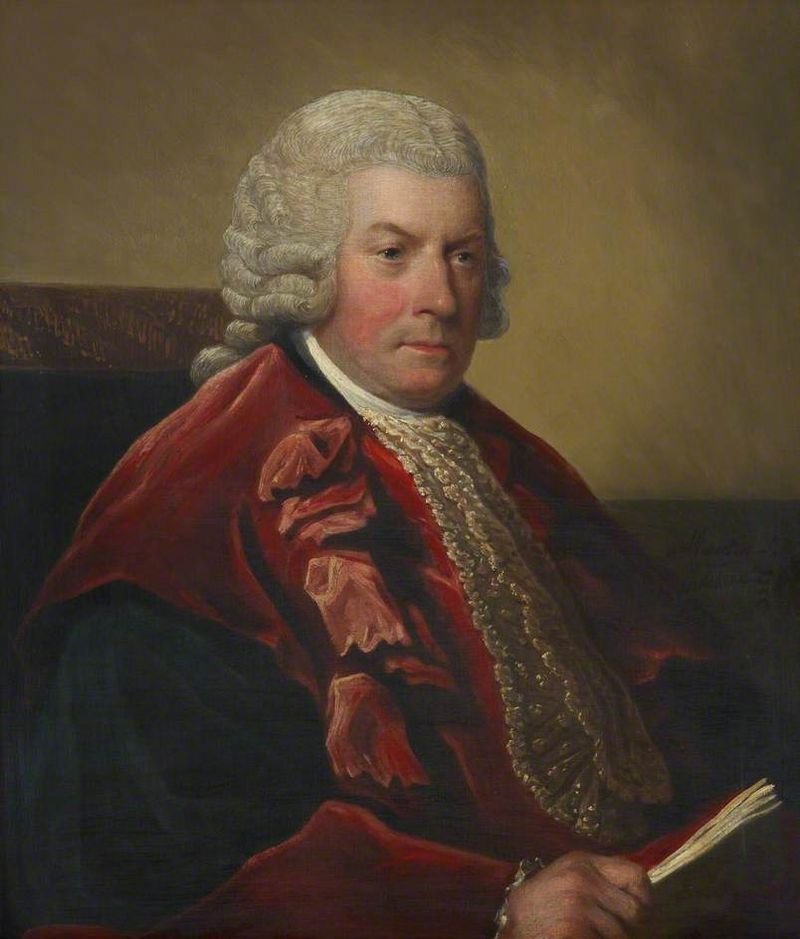
Sir Ilay Campbell of Succoth (1734 - 1823) by David Martin
Probably the best known of the Campbells of Succoth was Sir Ilay, who rose to become Lord Advocate in 1790 and was one of the most influential men in Scotland at this time. During their occupancy, they provided support for several Maryhill institutions. Lady Elizabeth, wife of Ilay’s grandson Sir Archibald, provided small pensions for several impecunious local residents. The following Lady Campbell, wife of Sir George, went further by financing the building of a cottage hospital, a building that survives today at 2024 Maryhill Road.
Inevitably there came a point where the Campbells were no longer able to maintain their position at Garscube and, in 1947, it was sold off to the University of Glasgow, the Maryhill section today being occupied by the Science Park, where space satellites are designed for international customers.
The final estate is Killermont, the bulk of which forms the golf course, with its magnificent Georgian clubhouse. In the early 16th century it had belonged to Sir John Cunningham but, after several other owners, in 1747 it passed into the hands of Lawrence Colquhoun. This family remained in charge throughout the 19th and early 20th century, having changed their name to Campbell-Colquhoun when the estate descended through the female line. Although their contribution to Maryhill was less, they did finance the building of the second Parish School and a later extension, this being on the site of the present Maryhill Parish Church. Originally, all of the estate had been on the western side of the Kelvin but at one point the area known as Sandyflats on the Maryhill side was purchased from the Grahams of Gairbraid. Today a large part of this area is occupied by the Riding for the Disabled Equestrian Centre.
The author of this essay is a retired training manager who carries out research into less well known areas of local history in Glasgow and the West of Scotland. As a Maryhill native he has a particular interest in the history of the area and, especially, that of the old police burgh up until 1891. These essays are taken from the research notes that have been drawn up over a period of years and are intended as an introduction which can be used by those seeking more information.
Maryhill Burgh Halls Trust want to thank William Black for his incredible support throughout the years, having shared all his in-depth research and snippets since the start of the Trust’s journey into the history of the Burgh. We are also very grateful for allowing us to post his wonderful essays to our blog. This is the second one of the series, you can read the first one on shipbuilding by clicking here.
Shipbuilding in the Burgh of Maryhill
Words by William B. Black
‘The Boatbuilder’ by Adam & Small (1878), Glasgow Museums
Situated some distance from the Clyde Maryhill may appear an unlikely situation for a shipbuilding yard but, during the 19th century it produced a significant number of vessels, both coastal and deep sea.
By May 1779 the Forth & Clyde canal had reached Stockingfield but further progress westwards had been suspended due to lack of funds. However, despite this, Robert McKell, the canal engineer, was instructed to obtain estimates for the construction of a graving dock at the western terminus. This did not proceed but, ten years later, with the canal again being driven towards the Clyde, it was revived. After crossing the Garscube Toll Rd, Maryhill Rd., the canal took a sharp turn west, then descend to cross the Kelvin. This left a short piece of land on the north side, on which the current engineer, Robert Whitworth, suggested the postponed dock could be built.
This was agreed and, by October 1789 it had been completed, access being via sluice gates on the north side of the circular basin between locks 22 and 23. The lock was 145 ft. (45 m.) long, 40 ft. (12 m.) wide at the top and 30 ft. (9 m.) at the bottom. Flooding the dock was through vertical sluices in the dock gates, while draining was by gravity, a sluice on the west side giving access to a tunnel which ran through to discharge into the basin below lock 22. As the normal lock chambers in the canal were 70 ft. (22 m.), this meant that two vessels could be handled simultaneously within the dock.
Initially the intention was that the dock would be used for repair and maintenance of craft operating on the canal and the first tenant was John Drysdale, from Carronshore. He was provided with a house but no salary, being expected to obtain his income from the charges made for working on boats, less the docking fee to be paid to the canal company. Although referred to as Gairbraid Dock initially, within six months it was renamed Kelvin Dock, the name it has retained since. Concentrating on completion of the canal the management failed to decide the docking fees properly and, after complaints about high prices, revised them in consultation with Drysdale and Nichol Baird, the canal surveyor.
The first vessel built at Kelvin Dock was a wooden icebreaker, which was completed by November 1790 and used to keep the waterway free during the winter. Drysdale struggled for most of his tenancy, being required to seek financial support from the canal management in 1795. Much of his work continued to be repairs and maintenance, although he did build one brigantine of 38 tons, named James and, in February 1800, Baird had his tenancy revoked. This action may not have been objective as the new tenants were his sons Hugh and Robert, already operating a small woodyard and foundry at Hamiltonhill. During Drysdale’s tenancy he did not have a monopoly on canal repair work but this was given to the Baird brothers. For which they paid an annual rent of £50. They did not operate the dock directly, employing a shipwright named Thomas Morrison to do so, who lived in the house vacated by Drysdale. This had an interesting clause in its lease, the occupants being required to provide ale ‘at any hour’ for persons transiting the canal. This building stood below the White House, close to the site occupied today by a bungalow.
Morrison built at least four vessels, while working for Baird, including Morning Star of 1813, one of the track boats that ferried passengers on a daily service from Glasgow to Port Downie, for transfer to coaches to journey on to Edinburgh. When Thomas died in 1816, his son John took over the management, before obtaining the tenancy a few years later. There no records of ships being built before Morrison indicated in 1836 that failing health would require him to retire. His place was taken by David Swan Jr, whose family had been operating a shipyard at Blackhill on the Monkland Canal since 1827 and the dock entered a new phase in its history.

Portrait of David Swan Jr
Swan was an ambitious man, who was to become the driving force in the creation of the burgh of Maryhill in 1856. His first new build was the cutter Cyclops, a cutter built for James McNair of Greenock, followed by a range of coastal schooners and by 1841 he was employing eleven carpenters, plus eight apprentices. West of the dock he established a timber yard, importing ready cut wood from Norway against opposition from other local merchants.
However, after a slow start, Swan’s timber business prospered and he diversified into the importation of ice, also from Scandinavia. When the dissenters of Maryhill were forced to leave the parish church in 1847, Swan offered the use of the covered sawpit as a temporary place of worship, leading to its being dubbed ‘Maryhill Cathedral.’
The Swan family had retained the use of the Blackhill yard but, increasingly, there was an interchange with Maryhill. The youngest brother, William had joined the timber business, although his inclination was towards engineering, while the other pair, John and Robert, concentrated on shipbuilding and David increased his involvement in the timber business. His son, also David, had moved to Australia and, when gold was discovered there, the elder David seized another opportunity. He built several schooners to his own account. Manned them locally, including several shipwrights, who wished to emigrate and, loaded with cargo, also purchased by Swan, set off for Melbourne. All of these vessels were no more than 66 ft. (20 m) long, yet travelled safely halfway round the world, before being sold, along with their cargo, on arrival. All of them continued to serve along the Australian coast for several years, a testament to the quality of Maryhill shipbuilding.
Following the introduction of the two younger brothers to the yard, construction of iron hulled vessels became the norm, including a lighter for the canal owners, named Thomas. Since Charlotte Dundas had sailed past Stockingfield in 1803 steam navigation on the canal had stuttered but, in 1857, it took a serious step forward. A simple steam engine, powering through a stern screw, was fitted to Thomas at Hamiltonhill and proved successful, so it was agreed to pursue the matter further. The Glasgow shipowner, William Sloan & Co received inducements to order three vessels from Kelvin Dock, designed to transport materials through the canal. The first of these was the Glasgow, launched in November 1857 and considered the first production version of the steam lighter, better known to everybody in the West of Scotland as the puffer.
Although the dock could handle vessels up to 150 ft. (46 m.,) the lock lengths limited hull lengths to 66 ft. (20 m.,) preventing the Swans to build the larger sea going and coastal vessels now becoming common. This was overcome by the simple expedient of constructing them in sections, then floating them down to Bowling, where they were joined together. This led to a witticism that suggested Kelvin Dock was building ships 9 miles long, their bows being in Maryhill and sterns in Bowling. In addition, it resulted in the publication of a little poem in the Dumbarton Herald of 18th August 1878, more McGonnigle than Burns:
Ships are built here of breadth of beam
To meet the merchant’s view
Seagoing ships for sails or steam
Down to Rob Roy canoes
Big ones are built Yankee style
A mile or so, as fits
And then (methinks I see you smile)
Cut off and launched in bits
To enable the building of more than two sections, an additional slipway was built on the opposite side of the basin, adjacent to the dock. Then the opportunity arose to obtain a better site than Bowling for the connection of the sections, the defunct shipyard of Morton, Wylde & Co at Dumbarton being obtained in 1871. Robert had died suddenly in 1860 but John and William continued under the original name, transferring construction of the larger vessels to Dumbarton after it was obtained. By now competition from larger yards on the Clyde was becoming more serious and, in 1874, Dumbarton was given up. At the same time others were entering the trade of puffer building, notably J & J Hay at Kirkintilloch and William Burrell and Son at Hamiltonhill, both former customers at Kelvin Dock.
August 1878 saw another first, with the simultaneous launch of two small steamers, Cartsburn & Cartsdyke. However, by this time the Swan connection was coming to an end, John retiring in the same year. A spelter works had been built on the west bank of the canal, opposite the yard, initially to provide fittings for the new vessels. It does not appear to have prospered for very long, although it was run by David Swan Jr., son of the founder of the business. Neither he nor William’s son, also David, appear to have taken any part in the shipyard and, when William retired in 1889, the direct family connection ceased. Andrew Marshall, William’s brother-in-law achieved control, retaining it until 1910, when it passed to Richard Munro Jr. & Co.

Kelvin Dock in 1943 by Francis Partick Martin, Glasgow Museums
During World War 1 the yard was taken into the control of the Inland Water Transport Department, being used mainly to convert scows to carry oil to Grangemouth. Post war, like most of the shipbuilding industry, Kelvin Dock suffered from lack of work, the last puffers being built there being the Kype and Logan of 1921. William McNichol had been the yard manager for many years, having succeeded his father, Charles in the post. Along with his brother, another Charles, who was a shipwright, they took over control of the yard in 1921, concentrating mainly on repair work. They built two steel hulled yachts and, produced a design for a two ton vessel in 1937, but nothing more came out of the yard at this period. With the return of war in 1939 the yard became involved in naval work and at some point, much of the dock was covered in, allowing work to continue through the night. By 1943 there were 200 men working at the yard, producing small landing craft, in preparation for the invasion of Europe. Post war the yard did not recover, being closed in 1939 and becoming a repository for various wrecks and derelicts until the canal closed in 1962. With the reopening of the canal the area round the dock has been refurbished and landscaped, the latter removing the last traces of the old slipways. New gates were erected at the mouth of the dock but, without sluices and the original drain sluice not having been reinstated, the dock cannot be brought into operation once more.
As well as Kelvin Dock, a second small shipyard operated for a brief period at Firhill, just east of the later site of Shaw & McInnes’ foundry and just inside the burgh boundary. This was opened by two shipwrights, Robert Ferguson and James McIntyre, in 1957, using a kidney shaped inlet on the north side of the timber basin, with an adjacent sawpit. They built four vessels before going out of business in 1867, the last being a composite hulled yawl Christina Ferguson, the only vessel of this hull construction completed on the canal. Today there is no visible trace of this short-lived venture.
The author of this essay is a retired training manager who carries out research into less well known areas of local history in Glasgow and the West of Scotland. As a Maryhill native he has a particular interest in the history of the area and, especially, that of the old police burgh up until 1891. These essays are taken from the research notes that have been drawn up over a period of years and are intended as an introduction which can be used by those seeking more information.
Maryhill Burgh Halls Trust want to thank William Black for his incredible support throughout the years, having shared all his in-depth research and snippets since the start of the Trust’s journey into the history of the Burgh. We are also very grateful for allowing us to post his wonderful essays to our blog. This is just one of many, there will be more to come.
Fine Dining in Maryhill Burgh Halls - A Reflection and Random Thoughts
Words by John Thomson
A Maryhill Dinner, 1908
When we think of eating out in Maryhill these days we may associate it with exquisite chips and colourful curries, but once upon a time when you wanted an all male dinner to celebrate something big, then there was only one place to go – the big hall of Maryhill Burgh Halls, or its predecessor.
And, yes, in those days these dinners were ‘all male’ and relatively formal, but they are part of the history of the Halls so let’s take a culinary journey back in time.
Let’s begin with 25th January, 1858 - ‘a notable evening in Maryhill… when a large number of inhabitants met in the newly erected Burgh Hall, Main Street….to partake of cake and wine’ – and the reason for the celebration? It was the marriage of the Princess Royal of Great Britain to Prince Frederick of Prussia, eldest son of the Crown Prince William. There’s not much in the newspapers of the time about the official celebration but that may be because no-one checked when the public houses closed that night. After all, it was an area where often, on a Saturday night, a ruction would be got up ‘when a few of the bhoys got some shebeen whiskey’ and I’m sure that would have been well shared.
The following year was much different in terms of celebrations. It wasn’t a royal occasion but it was the centenary of the birth of ‘our national poet, Robert Burns and the Hall was decked out with flags, evergreens, &c. and about 100 gentlemen sat down to dinner’.
‘This 25th of January was always reckoned and spoken of as the great red letter day in the Burgh and the few still surviving (1894) who were present at the banquet that evening look back with pleasing memories of the bright and happy social meeting.’
There’s little written about what was eaten and a menu of one of the dinners would be good but special occasions in those days deserved special foods and amongst the most popular were the likes of mulligatawny soup followed by saddle of mutton (where the saddle was hung for ten days covered all over in flour, suspended over a hot fire and served very hot with red currant jelly).
For pudding? How about a ‘conservative pudding’ which was a steamed pudding made with sponge cake, ratafias, macaroons, rum, cream, preserved cherries and served with a simple syrup flavoured with laurel leaf and almond. (gailcarriger.com)
But the good burghers did not always meet to celebrate prominent anniversaries and major events. There was a wide range of institutions and societies in the area, including The Kelvindock Curling Club, whose annual dinners included ‘corned beef and greens, with a goodly number of etceteras. Then followed plenty of ‘reekin’ toddy, songs, toasts and stories’ and the festive band ‘toddled hame between the key-stone o’ night and the wee short hour, unco’ happy.’
One other prominent society of the time was the Agricultural Society which organised an annual cattle and horse show. It was held in a small field adjoining Bonville House and the road leading to Dawsholm Paper Works. However, it later ceased to exist but it does offer a different feel to the Maryhill of tenements, workshops and hostelries that we often associate with that period.
Now, the photograph that accompanies this feature is taken from the Halls’ archives but all it offers in terms of a date is just 1908. However, when, earlier on, I spoke of ‘all male’, this is what I meant. Look at the moustaches; look at how they’re all dressed; and look at how well they fill the hall.
However, there was a dinner that took place in November 1909 that was covered in the Glasgow Herald and which gives an idea of the serious topics that could be covered at these dinners. This was ‘the eighth annual dinner of the Old Maryhill Neighbourly Society’ and ‘despite the unfavourable nature of the weather’ nearly 200 people attended. The dinner was presided over by Sir Archibald S.L. Campbell of Succoth with Cllr Walter Nelson as croupier. Now the job of croupier at a public dinner was nothing to do with roulette and blackjack but was to assist the chairman (as it would have been in those days) with running the dinner.
Amongst the guests were Lord Provost McInnes Shaw and Colonel William Lamont whose job it was to acknowledge the toast to the ‘Imperial Forces’ when it was given. It was all very formal but three things leap out from reading the article which are of interest to us today.
One, according to the Lord Provost, was the improvement to the district of Maryhill since the amalgamation with Glasgow had taken place. The second, interesting in these environmentally friendly days, was concern about purification of the air, particularly in Lambhill, where there were ‘large chimneys belching forth smoke’ but Glasgow had no control over these and wouldn’t until there was an amalgamation (Applause),’ The final suggestion was that Glasgow should ‘purchase the harbour tunnel in order to give Govan more direct communication with the city (Applause)’. Still no word of what they ate but ‘other toasts were submitted during the evening.’ It sounds like it might have been a long night.
And then the final dinner in this random selection took place immediately after ‘the war to end all wars had ended’ (WWI) - except more wars were to follow - but this would explain the importance of the first toast to ‘The Imperial Forces’, as had been offered in 1909 when the nation was still recovering from the Boer Wars but with WWI on the horizon, and the ‘toast was enthusiastically pledged, the company joining heartily in the singing of Rule Britannia.’ Mr James Menzies then contributed with a comic song and the evening moved on.
There were a few other toasts including ‘Success to Maryhill’ which began by recognising the importance of the Gairbraid Estate and the Hill family, moved on through recollections of the celebration of the wedding of the, then, Prince of Wales in 1863 which saw ‘illumination and fireworks’ and ‘the front of the old Burgh Buildings was beautifully decorated and in the centre was the coat of arms of the Prince of Wales all lit up with gas.’
But, as well as all these toasts, the evening – and it seems a long one – had various interludes when people like Mr P. A. Menzies and Parish Councillor A.M. Horne both contributed songs and. at one point, Mr D. M. Alexander ‘told a story that created heavy laughter’ but there is no more information on what was involved in that entertainment.
However, before I finish as I’m beginning to get a wee bit hungry with all this talk of dinners, one of the other things that caught my eye was discussion as to whether the Tramway Committee should run cars down to the shores of Loch Long, and probably erect a bridge to link up Ardgoil with the city!
Why was this even a topic for discussion? Well, it had ‘practically been settled that a new road or boulevard (was) to be formed from Anniesland to Bowling’ but there was also recognition of the need for social reform ‘which embraces the housing problem and cross-river communication.’.
So, four dinners, all of which took place within the Maryhill Burgh Halls (or its predecessor) and, within all the wining and dining, there was still time to consider the needs of the community and after dinner conversations which still have an effect on us today – over one hundred years later.
I’d like to thank Maryhill Burgh Halls archives for their help with this article and Random Notes and Rambling Recollections of Drydock, the Dock or Kelvindock. All Now Known by the Modern Name of Maryhill. 1750-1894 by Alexander Thomson which is available online.
Building Maryhill Burgh Halls in 1876-1878
Words by Aurora Segnan
Stonework detail by Charles B Grassby on the facade of Maryhill Burgh Halls.
Maryhill Burgh Halls Trust has been taking care of the building for twelve years.
From the regeneration project, which gave new life and shape to the Halls, to the everyday maintenance jobs, we work with many contractors with different specialisms and knowledge. But what was it like back in the day? The Glasgow City Archives may have some answers!
Last year we visited the Mitchell Library and found archival material relating to the construction of the building from 1878. What we know today as the Burgh Halls complex was then divided into two separate areas referred to as the ‘Public Hall’ and ‘Police Station. However, the Maryhill Burgh minutes from the years we are interested in have long been lost, which means we cannot dive too deeply into the construction process.
By the 1870s, Maryhill had been an independent Police Burgh for about twenty years. It had its own six elected magistrates (called ‘police commissioners’) who took care of lighting, paving, cleansing, and the water and gas supplies. Initially based in a building in Fingal Street, by autumn 1874 the Burgh Commissioners bought the land at the corner of Wyndford Street (the old name for Maryhill Road) and Gairbraid Avenue to create a larger space in line with the needs of a growing population and busier burgh. That particular piece of land still belonged to Mary Hill’s descendants and was tenanted by a John Keir, a cattle dealer with five acres of land to work on. As soon as it became available, the piece of land was recognised as being the perfect location for the new municipal buildings of the Burgh.
Six architects were invited to a competition to design the new Burgh buildings with Duncan McNaughtan (1845-1912) becoming the eventual winner. The complex costed an exorbitant £15,000 and it took just about two years to complete. The construction started in mid-1876 with senior magistrate James Shaw laying the foundation and officially opened on 26th April 1878.
The Glasgow City Archives have a wonderful document from circa 1878 which lists all the contractors who were ultimately selected to complete the works with individual costs. The document is called ‘’Statement of Amounts of Accounts for Municipal Building + Public Hall at Corner of Wyndford Street and Gairbraid Avenue’’. We are still to conduct any in-depth research into the companies, but most contractors were found in the local Post Office directory. What we get is a fantastic insight into the individuals who contributed to create the iconic Maryhill Burgh Halls and into the manufacturing industry in Glasgow as a whole. Only one manufacturer appears to be from outside the city and Scotland, with the kitchen furniture coming from Sheffield.
From some quick research into newspapers of the time, we also found that some of the companies worked on multiple projects together and on other recognisable buildings in the city. For example, the slaters Mackay worked with painter Andrew Wells in the Struthers Memorial Church (then Belhaven) in Hyndland. Similarly, Wells worked with Adam & Small on the Albert Street United Presbyterian Church in Townhead. Another particularly interesting individual is Hull-born sculptor Charles Benham Grassby (1834-1910) who did some stone carving all over the city, including on the old Glasgow Herald building in Buchanan Street and on the old BBC offices in Queen Margaret Drive. Grassby’s detailed work on the Burgh Halls can be seen here.
One final note about Andrew Wells is that he is a decorative painter. In his contract there’s a breakdown of his work which details that the official rooms of the commissioners were ornate with stencilled friezes. Coincidentally, some decoration in the Main Hall can be seen in a photograph of an Old Maryhill dinner dated 1908. At the very back, above the wooden balcony, there’s a decorative freeze and some writing – the only words we can discern are ‘literature’ and ‘mining’. Sadly, we haven’t replicated any of that today.
Below is a table copied from the GCC Archive’s document with added information about the company or traders taken from post office directories from the same years. Please let us know if you have any interesting information about any of the traders.
| Job | Contractor | Address | Notes | Cost | |
| Mason Work | J & W Murray | 197 Gaibraid Street | John Murray, Rockview House, Maryhill (contractor, quarrymaster, brickmaker) | £5058 4s 9d | |
| Digging Work | James Elder | 209 St Vincent Street | James Elder, 3 South Apsley Place (civil engineer, surveyor) - Burgh surveyor, 1880-1887 | £327 10s 10d | |
| Wright | Archibald MacFarlane | 38 Arlington Street | Archibald Macfarlane, 40 Arlington Street (wright, builder) | £2,470 | |
| Slating Work | A & D Mackay | 35 Oswald Street | Daniel Mackay, 296 St Vincent St (slater, slate merchant) & Alexander Mackay, St Andrews Road, Pollokshaws (slate merchants) | £315 10s | |
| Plumbing | Nevay & Menzies | 121 Main Street | Alexander Nevay, 152 Main Street (plumber, gasfitter) & Robert Menzies, 8 Kingston Place (plumber) | £380 14s 9½d | |
| Plasterering | James Steel Junior | 65 Bath Lane | James Steel Jr, 56 Hill Street (modeller, plasterer) | £743 8s 10d | |
| Smith Work | James Croll | 200 & 202 Rottenrow | James Croll, 1 North Ure Place (smith, machine maker) | £255 7s 1d | |
| Stone Carving | Charles B Grassby | 37 Bothwell Street | Charles B Grassby, 38 Belmont Place, Hillhead (monumental builder, sculptor) | £96 14s 6d | |
| Gasfitting | R.C. Murray | 4,7,9 Carlton Court, Bridge Street | manufacturing, tinsmith, coppersmith, plumber, zinc worker, gasfitter, bellhanger, hotel/ship/street lamp maker | £54 | |
| Painting | Andrew Wells | 206 West George Street | Andrew Wells, 13 Nelson Terrace, Hillhead (house and church decorator) | £160 | |
| Tiling | Strathie, D. & Co | 193 Sauchiehall Street | David Strathie, 42 Cambridge Street (mosaic and encaustic paving tile layers and wall decorators; depot for Minton, Hollins & Co, patent flooring and encaustic tiles) | £29 10s | |
| Heating & Ventilation | James Combe & Sons | 59 Cathedral Street | William Combe, 22 Dundas Street (heating and ventilating engineers, hot-house builders) | £250 4s | |
| Glass | Adam & Small | 201 St Vincent Street | Stephen Adam, 4 Cathkin Terrace, Mount Florida (glazier, glass-stainer, decorator) | £150 | |
| SUNDRIES | |||||
| Grates, Gasalier & Coronae | James Brown | not found | £93 4s 3d | ||
| Gasalier | James Gray, Son & Co | 115 Union St & 51 Gordon St | (furnishing ironmongers, electro plates and cutlery merchants) | £46 | |
| Furniture | Alexander Cree & Co | 34 Bothwell Street/75 Port Street | Alexander Cree, 30 St Vincent Crescent (upholsterers, cabinetmaker) | £120 | |
| Venetian Blinds | Falconer & McKinnon | 112 Bothwell Street | D. Falconer (449 St Vincent Street) | £32 10s | |
| Street Lamps | Turner Brothers | 119 & 121 Bothwell Street | Budhill Iron Works of David Turner (148 Bellfield Street) | £55 | |
| Kitchen Furnishing | Longden & Co | 15 Furnace Hill, Sheffield | Based at Phoenix Foundry (iron funders, manufacturers of stove grates, cooking and heating apparatus, stair balusters, fence railing, case hardened and grain rolls, and castings for heavy mill work) | £27 | |
| Beams for Main Staircase | Oak Foundry | Black Street | architectural ironfounders, sanitary engineers | £3 | |
| Wood Mantlepiece | Angus Mckay | 43 Robertson Lane | Cabinetmaker | £8 10s | |
| Chairs | Alexander & Howell | 108 St Vincent Street | Art house furnishing of William Alexander (Elmbank, Lenzie) & Edward Howell (Inglebank, Lenzie) | £13 6s | |
Maryhilll Burgh Halls is a wonderful and incredible asset, representative of the unique history of the local Burgh. It’s more than bricks and mortar - they are expression of Maryhill’s own identity, belonging and pride in this fantastic area. If you wish to support us as we keep taking care of the Halls, you can donate at this link or at the donation boxes located at reception.
The Statement of Accounts is held at the Mitchell Library by Glasgow City Archives and is referenced as H-MAR/5/54. This is just one of the documents connected to the Burgh years that is in safekeeping at the archives, there’s still a lot to discover about the wonderful Maryhill!
Thank you so much to the archivists at Glasgow City Archives who are always very helpful and patient.
John Turnbull: A Maryhill Police OffIcer
Words by John Thomson
Maryhill came into being as a burgh in 1856 but it was already a flourishing township with workmen coming from all over to work on the expanding Forth and Clyde Canal. It was a raucous place and badly needed a police force to control its expansion. It got one that year as part of the Glasgow Police Force which was the first in the United Kingdom – even before the Metropolitan Police was formed. Its first home was opened in 1857 at the corner of Maryhill Road and Fingal Street and included a flat on the upper floor for the Superintendent of Police – ‘The Captain’ George Anderson.
Police Station before the Maryhill Burgh Halls Regeneration
But the Maryhill Police Force needed a bigger home and in 1878, with the building of Maryhill Burgh Halls, it got one. However, it wasn’t until 1972 that ‘rookie cop’, John Turnbull passed through its door as PC F227 for a busy career mostly spent in Maryhill until retirement, having joined the police force at the age of 19. He had been an electrician who had always wanted to join the police but was in a steady trade. However, a building strike at that time gave him the impetus he needed and he followed the steps of a pal in becoming a policeman.
Maryhill was a territory he knew well as he stayed in Trossachs Street and, in recent conversation with volunteer John Thomson, he shared his memories of the old police station – now part of the refurbished Maryhill Burgh Halls – in a Maryhill Road he described as ‘all tenement buildings up and down and with such a busy shopping area there was no need to go into town’.
The conversation started with a flashback in time and a tour of what used to be Maryhill Police Station before it moved to its new location at 1380 Maryhill Road in 1978. Coffees were shared in the Nolly Café which became the centrepiece of the ‘tour’ and John began by looking at the modern Halls reception area.
‘There was a door over there on the left hand side (at the reception area) with a large archway and there were stairs that took you up to CID. Where we’re sitting (by a window looking onto Gairbraid Avenue) was next to the telephonists’ room and the café itself was the main office with a charge bar and control room with the controller supervising what was happening. The main door to the public would have been where the museum windows are and that door would bring them to the reception, where we are. Community Involvement was also here as was the Enquiry Unit which checked licences for guns among other things and then there were stairs going up to the cells. There was about six of them and they were under the rule of the female turnkey who also had the responsibility of cooking breakfast for the prisoners before they went to court or other police stations. If there were people in the cells in the evening, then maybe she’d cook something more substantial like mince and tatties.
‘There were kennels in the courtyard but no police dogs were kept there. They were for stray dogs and any stolen, but recovered, cars or cars which were seized by the police for other reasons, were kept in a yard. Next door to CID was a janitor who also washed the police cars but on a Sunday we had to wash the cars ourselves and we had to really gut them out.
‘Through the courtyard was the snooker room and some other small offices. Our muster room was in the hall itself and we had to parade in the yard and there was a room for policewomen who, in those days mostly dealt with lost children and things like that. Mind you there were times when the very presence of a policewoman could quell a situation whereas a policeman might go in headstrong; ‘Right you, you’re going to jail’ – making the situation worse.’
But that was the police station. What was life actually like out on the beat?
John was mostly based down at Raeberry Street Police Box and the police boxes were important as they were seen as a police presence in the area.
‘People were drawn to them with complaints about street football and car parking. It was an important place for keeping records, such as the Shut Up House book which was a record of when people were away on holiday so you’d keep an eye on their property. That personal touch was important.’
But was it always as straightforward as that?

Two officers with a Stratchlyde police car Ford Capri, 1977. [Source]
‘At that time, when you’d finished your shift you’d put your radio into a locked box in the Police Box and head back to the office. One night I was heading back up Maryhill Road and I got to Queen’s Cross and the paper seller at the corner of Northpark Street had a crowd round him and they started shouting at me – obscenities and what not – but I didn’t have a radio with me because I’d put it in the locked box but I went across anyway and told them to calm down and to behave themselves and move on and one of them pulled a knife on me.
‘So I stepped back and walked slowly and deliberately back down to the box and phoned for assistance. However, by the time, assistance arrived, they’d dispersed. Mind you. We got them later……..
‘But that was the done thing. The others watching your back and you watching theirs. If you put out a call, you would have umpteen cars attending that call for assistance. Same with housebreakings or anything like that. I’ve seen me sitting in the car, just waiting to go into the office for refreshments and I’d get a call and it was straight back out.’
On another occasion John and a colleague were in their car and they were chasing a stolen vehicle.
‘The car slowed down and the lad bailed out and he ran through the back and I chased after him. But then, as he ran through the back, I just saw his legs going up in the air and he landed on his back. What had happened was he had ran into a clothes line round his neck that nearly took his head off.’
Hoist not so much by his own petard but by a Maryhill backcourt clothesline.
John, at one time a promising boxer, took retirement as a police constable from the now Strathclyde Police Force in July 2003, but came back in various capacities such as a station assistant up at Milngavie and as a Community Support Officer covering custody in various police stations, before eventually standing down in September, 2018. Maybe you can take the man out of the police force but not the police force out of the man.
The conversation took place during the recent exhibition of photos of old Maryhill taken by George Ward and after the chat with John, he stood in front of the video screen showing some of George’s cine footage. His impression of the halls? ‘Fantastic, and I met a few people who had stayed in Raeberry Street and we chatted for a while. Maryhill has lost its core but the people haven’t changed much. You still get all the friendly faces.’
Thanks for the conversation PC John Turnbull (F227) and you’re welcome back at Maryhill Burgh Halls any time.
The Collina House Mystery
Words by Elinor Abbott
Colina House or Collina Cottage?
Discover the mystery of Colina House - an exquisite property captured in family photos from the early 1900s. Follow our search for answers as we uncover the story of Maryhill's first provost, David Swan, and the possibility of his family's connection to the elusive Collina Cottage.
Stuart contacted Maryhill Burgh Halls, hoping we could help him find information on a cache of family photos showcasing early twentieth-century locations in Maryhill. These pictures had already undergone some research, which Stuart had done himself, aided by family mementoes and tokens.
The wedding invitation was particularly interesting to Stuart, which indicated the wedding was to take place at "Colina House". What was Colina House? And where was it? There were several photos of a bride standing in both the foyer and front steps of a large and nicely turned-out house. There was also a photo of a woman in a wide-brimmed hat, standing by a fountain at "Colina House". Stuart wondered if perhaps his family had worked in service, as he didn't think they had owned property back then. An old map he found indicated there was at one time, a building called "Collina" in Maryhill, where Collina Street is now.
Looking into the origin of Collina House, we discovered that Maryhill's first provost (similar to a mayor), David Swan, lived in a home called Collina Cottage, built around 1858. This home is described in an ordnance survey from that period as "A superior Cottage commanding a view of the whole of Maryhill." Could this be the same Collina House that Stuart's family's photos indicated?
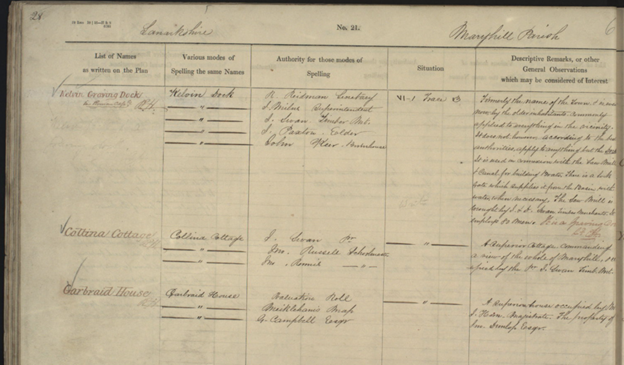
Doing map regression work shows that Collina Cottage, the one built by the Swan's, remained on local maps until 1933, at which point it disappeared. Stuart's photos would have been taken around the late teens/early 1920s. Housing ownership records did not turn up anything which indicated to who the Swan's may have sold Collina Cottage to, as that family relocated to Perthshire around 1907. There is a document which states a "Janet Ferguson" owned Collina Cottage in 1895, but this may be the married name of Janet Swan, daughter of David Swan, it is hard to say. Collina was certainly an important name to the Swan family, shipbuilders, who built a ship called the Collina (also called the Corie) in 1862.

Looking closer at Stuart's photographs of his family in the early twentieth century, it was noted that they did not have the appearance of servants, they were smartly dressed in a number of photographs, particularly one in which they are crowded around Isabella S.B Dunlop (née Bryce), Stuart's great grandmother, outside a stately home, perhaps the same one from the wedding and fountain photographs.

Though it is generally more difficult to find information about women than men when looking at historical records, Isabella S.B Dunlop (1850-1927) left behind many clues and questions when it came to Collina House. Isabella's full name was Isabella Sloss Bryce Dunlop, but another name came up when looking into records of her death. The National Probate Index of Scotland (a probate is what gives someone the legal right to the estate of another person and exists separately from a will) shows that Isabella also went by the name "Colina" (one 'L'). She willed what would be about £3,600 to her eldest daughter, Mary, in today's money.
Isabella's husband had been a blacksmith who owned the "Dunlop Forge." Isabella was widowed in 1921 and documents from this time show that she owned property on Hill Street, now called Duncruin Street, not far from Collina Cottage. This property was a workshop and ground house, at which a number of people lived and from which her son, Thomas, ran his carriage and horseshoe business, "Thomas B. Dunlop & Co." Was she living elsewhere? Was she also perhaps the owner of what was Collina Cottage, now called Colina House? We are waiting for the 1921 census to be released so we can explore who was living where.

The Dunlop Forge, Hill St.

Thomas B Dunlop & Co carriage company.
Isabella's two daughters also worked. Annie, Stuart's grandmother, was a ladies mantle maker, a mantle being a type of overcoat, and one of the most impressive photos Stuart provided to Maryhill Museum was of Annie at work. Images of women at the time working are quite rare. Annie's younger sister, Isabella, also worked in textiles as a cutter of undergarments.
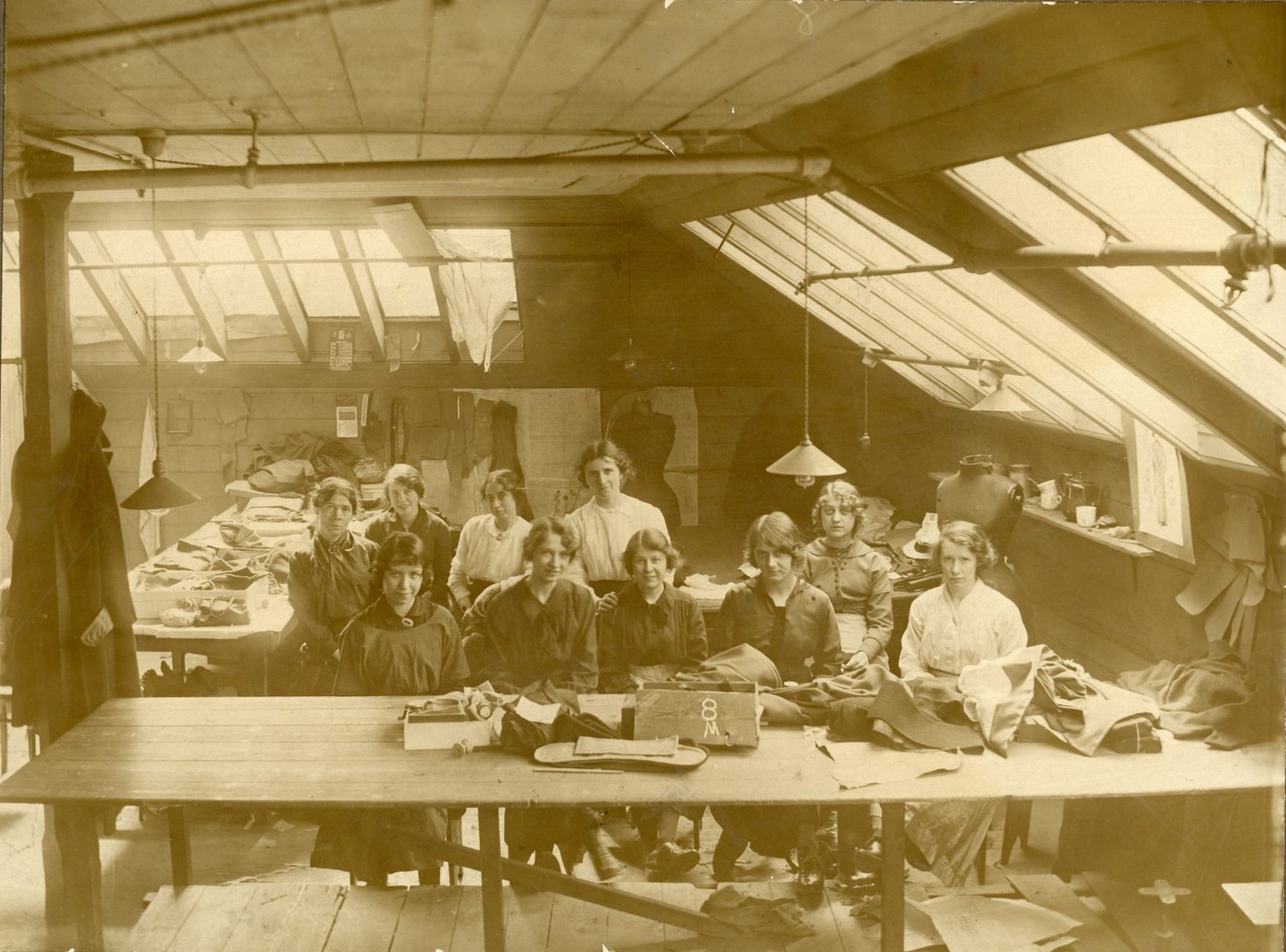
Tailor Workshop. Annie is in the first row, second one to the right.
Annie was married on December 31st, 1920 at 135 Burnhouse Street, there is still a church in this location. This is listed as 'residence' on the marriage certificate, but this is likely the residence of the church where they were married, though the images of Annie being married were taken at the mysterious "Colina House". Stuart related that family lore states that Annie's wedding celebration at Colina House went on for two days. It seems unlikely that the Dunlop family would be able to celebrate for two days anywhere besides their own home. So it becomes less plausible that the Dunlops rented Colina House for the wedding. Stuart also related a memory passed down through his family of Colina House, having a path for boats that stretched from the house down to a dock on the canal. This also indicates that the Dunlops may have come into possession of Collina Cottage, as the Swans were shipbuilders.

Colina/Collina is an unusual word. In the case of the Swan family, it could be used to indicate the location of "Collina Cottage", on top of a hill overlooking Maryhill, as the word "Collina" means hill in Italian. However, that is conjecture and we don't know if the Swan family spoke Italian or had connections to Italy. In the case of the Dunlops, did they purchase Collina Cottage and live there while owning property on Duncruin Street, which they rented out? Was Isabella S.B Dunlop connected to Collina Cottage in some other way? Born there, perhaps? Or was it simply a coincidence? Strange, however, to have two homes, "Collina Cottage" and "Colina House" so close to each other during the same period of time, as well as for Isabella to have acquired the nickname 'Colina'. It's possible that Isabella fancied the name "Collina" and named her own home after it and subsequently acquired it as a nickname.
When the 1921 census is released, we hope we can discover more!
If you have any information about Collina House, please get in touch! info@mbht.org.uk
Maryhill and the ‘Ghost’ Junction
Words by a volunteer
If you have ever travelled westbound on the city centre section of the M8, you may have noticed a junction just before junction 17 that leads to a dead end. This ‘ghost’ junction is shown in the photograph below. Naturally, you may have wondered why such an, ostensibly, superfluous addition to the motorway had been constructed?
The answer to this question is directly linked to Maryhill.

The ‘ghost’ junction on the M8 (The Scotsman)
The origins of the M8 motorway lie in the Bruce Report (or the First Planning Report to the Highways and Planning Committee of the Corporation of the City of Glasgow), which was published in 1945. The Bruce report was essentially a plan for the development of Glasgow which made several recommendations. Had it been implemented fully, central Glasgow would be very different from the central Glasgow that we know today.
For instance, the report recommended the demolition of Central Station, the Royal Infirmary, Glasgow City Chambers, and the Kelvingrove Museum, which did not go forward. However, one of the plan’s recommendations which was implemented was slum clearances and the construction of housing estates (such as Castlemilk, Drumchapel, and Easterhouse) on the periphery of Glasgow’s boundary.
Another of the plan’s recommendations, which was ultimately only partially implemented, was the construction of a box shaped inner Glasgow ring road (encircling Glasgow city centre) connected to several arterial motorways that were to run through four corners of the city.
Completed in 1972, the city centre section of the M8 forms the first half of the circumference of the proposed ring road. One of the arterial motorways was to connect the ring road to a motorway that would run through west of the city. This motorway would have run through Maryhill and was to be named the M81. The now ghost junction would have been the connection between the M8 and Maryhill.
When the plans for the Maryhill motorway were being drawn up, the Forth and Clyde canal was closed to navigation. Part of the route the Maryhill Motorway was to be built on the route of the canal, with the canal being diverted through underground pipes so that local industrial activity that relied of the water suppled by it could continue.
The two images below show the southern portion of the proposed motorway and the northern section of the proposed motorway respectively. The southern section was to connect with the city centre section of the M8 between junction 16 and 17. The plans for the southern section include slip roads on Possil Road and Bilsland Drive. The northern section would have left the route of the canal of Stockingfield lock. It also curved around the, then in the planning stage, Summerston residential development.

Southern Section (Glasgow Motorway Archive)

Northern Section (Glasgow Motorway Archive)
Consultation with the local public took place during the design phase of the Maryhill motorway. For example, a public meeting took place at Woodside Hall on the 26th of October 1972 that was attended by officials from Glasgow Corporation and elected representatives, whilst a public exhibition took place in Methodist Central Hall between the 24th of October 1972 and 28th of October 1972 that was attended by more than 3,300 people.
This public participation influenced the design of the motorway. However, strong opposition to the Maryhill Motorway from residents of Maryhill resulted in plans for its construction to be cancelled in 1975. Interestingly, the local protests included songs, protest marches and public petitions.
Do you have any memories of the Maryhill motorway plan? Were you in favour or did you take part in any protests?
Much more information about the Maryhill Motorway can be found on the website of the Scottish Roads Archive here.

City, people, and history: The connection between The Glasgow Police Museum and Maryhill Burgh Halls
Words by Hsiao-Chiang Wang and Yen-Ting Lin
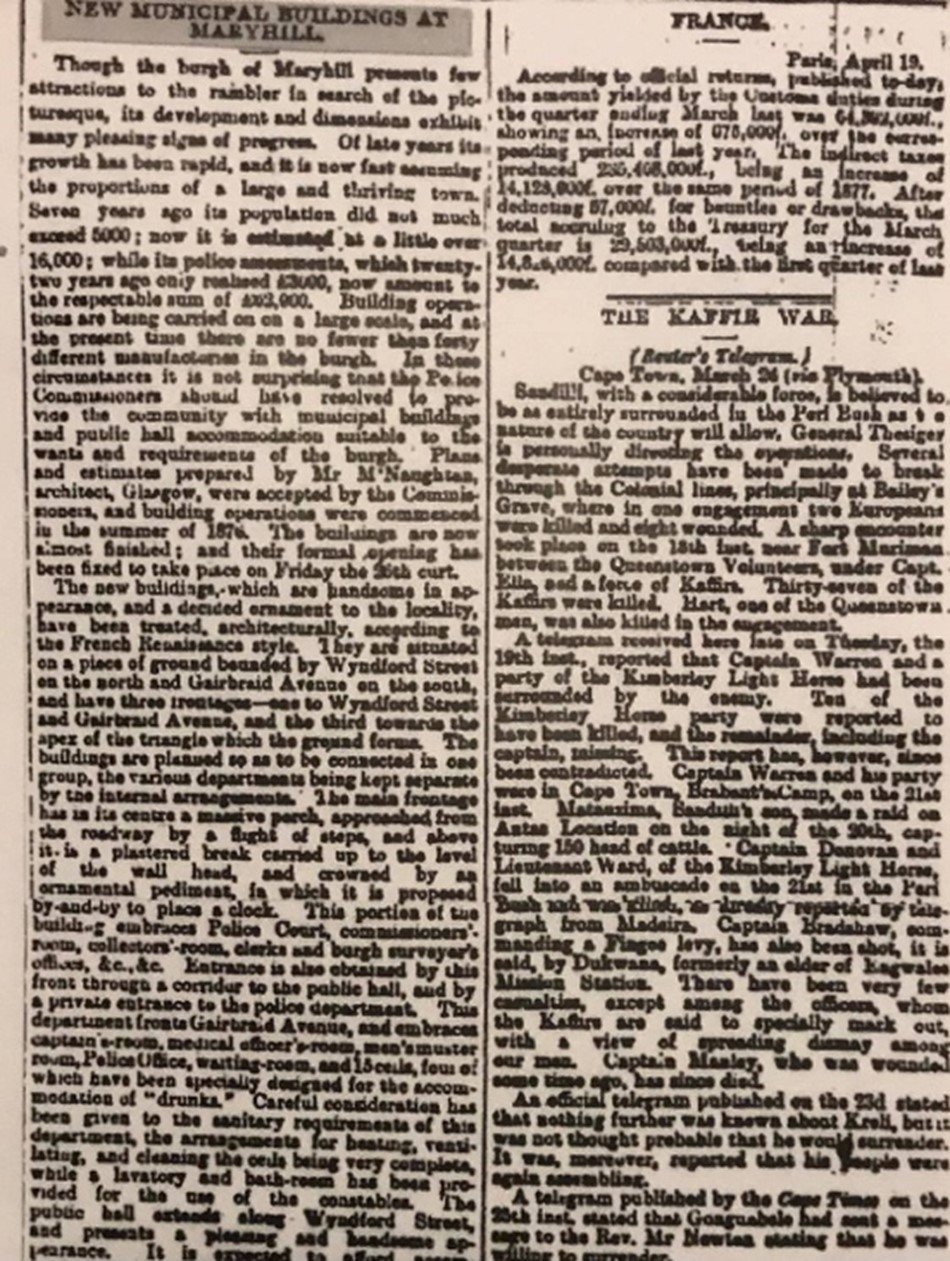
Newspaper clipping from 1878 reported the completion of new municipal buildings in Maryhill. It begins with a positive statement about the future of the area: ‘Through the Burgh of Maryhill presents few attractions to the rambler in search of the picturesque, its development and dimensions exhibit many pleasing signs of progress.’ [Glasgow Police Museum]

Original Maryhill Police Station, 1857. [Glasgow Police Museum]
At the heart of Maryhill is Maryhill Burgh Halls, and its purpose has changed many times. The Burgh Halls building opened in 1878 as a community space, as well as a centre for policing and local governing. Maryhill Burgh Police station was located within the building, meaning the Halls were once central to the growth and development of the area. Since then, the area has continued to flourish and the local police office has moved to a different location. As the Burgh Halls has continued to develop and contribute to the community through the arts, heritage and culture over the last decade, perhaps its history as a police station has been forgotten.
However, it is interesting that both the Police and the Burgh Halls have set up museums with the intention to preserve the history and memories for the people, consequently allowing this knowledge to be available to the wider public. To date, the Maryhill Burgh Halls has continued to fulfil this duty, remaining a hub that commits to serving the community as its priority.
Travelling back to around 1850 , there was a time when there were serious riots occurring in Glasgow due to the pressure generated by the trade depression in Scotland, and the political upheaval in Europe. Likewise, the consequences of radical changes in the area- brought about by a large itinerant workforce through projects like the construction of the Glasgow & Dunbartonshire Railway- and rising crime rates, meant that there was a demand for a Maryhill Police Burgh and this was founded in 1856. At the time Maryhill became a Burgh, ‘The Captain’ George Anderson, was appointed as the first superintendent. The first Police station was opened in 1857 at the corner of Maryhill Road and Fingal Street. It not only provided space for a court and magistrate’s chambers, but also accommodation for the officers.
Moving forward a few decades, the expansion of the Maryhill Police Burgh force and the request for improvement of the space, triggered the movement to build a new Burgh Halls and Police Station. As a result, the new police station was established within the Burgh building on Gairbraid Avenue, off Maryhill Road. The original Maryhill Police Burgh force was subsequently merged into the force of Glasgow Police in 1891 and became the Maryhill Division..

Burgh Halls and Police Station, opened in 1878.

Current Maryhill Police Station, opened in 1978.
An interesting fact is there are unique connections, between the previous location of the police station and the development of the museums today, through some notable people. For example, Sir Alastair Dinsmor, the founder of the Glasgow Police Heritage Society, played multiple roles related to Maryhill throughout his career, and is known as the main founder, general director and leading curator of the Glasgow Police Museum. Investing in his hobby of collecting, he has developed a riveting record of being an enthusiastic collector of police memorabilia. He has been collecting items for more than 55 years and a few are from Maryhill Burgh Police. Coincidently, he was also previously an inspector who served in the Maryhill division.

Alastair introducing the police history of Maryhill. [Hsiao-Chiang Wang]

Bronze Medal of Citizen of Maryhill. [Hsiao-Chiang Wang]
Alastair joined the police force at age 16, serving as a policeman in Glasgow for 33 years, starting in 1965. He served in Maryhill between 1993 and 1997. From his perspective as a former policeman, Alastair notes that Maryhill is a vivid area that accommodates a mixture of backgrounds of people. Apart from his daily work such as crime prevention, riot training, and firearm management, he also needed to supervise sales in the alcohol trade. Thus, he had to visit Maryhill Burgh Halls to carry out this work locally.
Initially, he was interested in military history but after joining the police force, his passion turned to the history of policing and how it has evolved within society. Because of his interest in police history - and his motivation to create connections with other nations - he started the International Police Collection, with items dating from 1966.
Currently Alastair owns more than 8,000 items from countries all over the world. After retiring from the force, he founded the Glasgow Police Heritage Society in 1988. He led a project to establish the police museum in Glasgow between 2000 and 2002. Finally, the Glasgow Police Museum opened in May of 2002. The museum was run by retired police officer volunteers from the Society, and it is supported entirely by public donations. Despite not having a background in museum work, Alastair learned a plethora of skills for operating the attraction, including computer programming, collection management, and museum operation. The museum reaches out to the public through storylines and narratives via the richness of the objects on display, putting into action its mission of serving the community, in much the same way as Maryhill Museum does.

Figure 7 The world police collections in the Glasgow Police Museum. (Photo taken by Hsiao-Chiang)
In 2016, Alastair was presented with an MBE by Prince William at Buckingham Palace for his dedication to preserving history. In addition, the operation of the Glasgow Police Museum was acknowledged when it won the 'Best Day Out' award at the Glasgow Awards in 2019. These awards not only recognise the positive impact of the museum in the Glasgow community and its civic culture, but also emphasise the importance of growing as a cultural attraction. This resonates with the spirit of Maryhill Burgh Halls, and highlights the impact and goals of the museum. Maryhill residents past and present can share memories and insights of the past and write the stories of the future. Both Glasgow Police Museum and Maryhill Museum share an ethos of cherishing the achievements of the city, the people and the history of their communities.
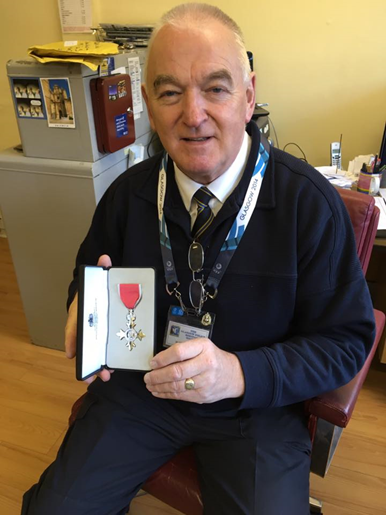
The Curator Alastair and his MBE award. [Hsiao-Chiang Wang]
Bibliography
Black, B. (no date) ‘Maryhill-Police& Fire’.
Dinsmor, A. (no date) INTERNATIONAL POLICE COLLECTION. Available at: https://adintpolcol.tripod.com/ (Accessed: 17 December 2021).
Maryhill – Glasgow Police Museum (no date). Available at: http://www.policemuseum.org.uk/burgh-police/maryhill/ (Accessed: 17 December 2021).
Scottish Apprenticeship Week 2022: Digital Media
Words by Anna Fernie
Hi! I’m Anna, and as part of Scottish Apprenticeship Week, I’m sharing my experience as an apprentice at Maryhill Burgh Halls. But first, lets talk about Scottish Apprenticeship week.
This special week is dedicated to promoting apprenticeships in Scotland, and all the incredible opportunities they can bring. From engineering to working with children, there are almost no limits to the variety of apprenticeships available. On top of that, they allow you to work in the field you choose, rather than being stuck in a classroom! There are several types of apprenticeships available, making these accessible to all ages and experience levels. Interested? I hope so, as this week is the perfect time to check out the options available and peek at the events happening. Click here to find out more!

Anna’s design 1

Anna’s design 2
My own experience as an apprentice has been incredibly positive, and I have loved working at the Halls. Being able to go out and gain experience in my field has been great, and has additionally really benefited my CV. Personally, I am completing a Foundation Apprenticeship in Creative and Digital Media and have been on this work placement since September.

Anna’s flyer for the Glasgow Orchestral Society exhibition
During the time I’ve been working at the Halls, I’ve worked on many different projects, but mainly the social media posts that you have been seeing in the past months. Not only I came up with content to post, but I also developed the captions and worked on the visuals. I was also asked to create a video to celebrate the events and achievements of 2021! From taking photographs to produce ad hoc images, I had the opportunity to learn about several aspects of digital communications.
The most exciting project I have worked on at the Halls has to be our newest exhibition, Glasgow Orchestral Society: Celebrating 100 Years. With the help of the incredible people working here, I created the poster and graphic for the exhibition, and seeing my work getting used in a real-world context was amazing and extremely rewarding.
If you are interested in learning through experience, I would highly recommend checking out apprenticeships, and seeing what works for you. With this being the perfect week to do so, there is even more information and opportunities available, so don’t miss out!
LGBT+ History Month: Reflecting on Glasgow
Words by Ian Perry
To celebrate LGBT+ history month, Maryhill Burgh Halls is reflecting on the progress of attitudes towards LGBTQ+ people in the surrounding area.
Glasgow, as a whole, was known for its social conservatism and strict religious views that were often strongly against LGBTQ+ people, relationships, behaviour, and expression. Two years following the opening of the halls, the Criminal Law Amendment Act of 1885 made male same-sex sexual acts a criminal offence, which carried a two-year prison sentence. Nearly a century later, Scotland partially decriminalised homosexuality in 1980, however, attitudes generally take time to catch up. This is demonstrated succinctly in 80s pop outfit Bronksi Beat’s video to their hit Smalltown Boy:
falsetto gay singer Jimmy Somerville is seen on a train, looking out the window at a passing urban scene, reminiscing about something that saddens him - we see a flashback of him admiring a chiselled, muscled straight guy, at a local swimming pool - he is beaten up by the guy and his pals in an alley outside - the police pick him up and take him home - as the policemen explain the reason for Jimmy's bruised face, his mother sobs, his father shakes his head and fists in disapproval, whilst Jimmy shamefully bows his head in their drab living room, resulting in him being kicked out of the family home, being slipped some cash, before boarding a train (the one from the beginning) with his pals and running away to the more queer-friendly big city of London.
Somerville undoubtedly used the bigotry he experienced growing up in his hometown of Milton, another working-class area of Glasgow, as the subject matter for the song and video, which depicted the kind of prejudice which was common in Glasgow during the 1980s. Prejudice was amplified nationwide in 1988 when Margaret Thatcher’s Conservative government introduced anti-gay policy in the form of Section 28 (or known as clause 2A in Scotland). The clause stopped local authorities from “intentionally promoting homosexuality” in any publicly-owned building, which included museums, galleries and libraries.
During the 1990s, grassroots activist organisation Glasgow Women’s Library sprung up in Garnethill (now based in Bridgeton). They played a significant role - under the guise of The Lesbian Avengers - in actively repealing the clause. Despite opposition from “committed Christian” Stagecoach owner Brian Souter’s ‘Keep the Clause’ campaign, the clause was successfully repealed in 2000 in Scotland.

Photograph of the Glasgow Lesbian Avengers holding the made banner ‘We Recruit’ and protesting with other placard ‘We Object’ against Section 28. Part of GWL’s archive collection. © Author’s own.
LGBTQ+ inequalities were polarised in Glasgow at the Gallery of Modern Art (GoMA) 2009 exhibition ‘sh[OUT]’. The exhibition had many pieces which stirred divisive debate and opinion; garnering a backlash from political and religious groups, and culminating in meetings between council members and the Archdiocese of Glasgow to censor the most controversial pieces. However, academics evaluating the exhibition found that it helped promote understanding of transgender and intersex equalities and rights, and they suggested this resulted in legislation like The Equality Act (2010) coming into effect.
Recently, Glasgow has seen a huge shift in attitudes and open-mindedness with regard to same-sex relationships and different gender expressions. A thriving LGBTQ+ nightlife and drag scene can be found all over the city; from big commercial venues Polo Lounge, AXM (formerly Bennett’s), and Delmonica’s, to new queer co-op venue Bonjour (opened in 2020, and formerly an old man’s pub), along with alternative, avant-guarde queer clubnights, such as Shoot Your Shot and Hot Mess. Maryhill itself has shown inclusivity by screening LGBTQ+ film favourites, such as John Waters’ Polyester, featuring drag legend Divine, at the Community Central Halls on Maryhill Road through Seaboard Neighbourhood Cinema in 2018. With Scottish Glasgow-based drag queen Lawrence Chaney being crowned the winner of the second series of RuPaul’s Drag Race UK in 2021, who’s next to claim the prize? A drag queen called Mary Hill, perhaps!
Glasgow Orchestral Society exhibition: Advertising the Society
Written by a volunteer
The Maryhill Museum is currently hosting an exhibition of archival material narrating the 150-years history of the Glasgow Orchestral Society.
The Glasgow Orchestral Society was formed on the 29th of December 1870 as an amateur musical group. They have used Maryhill Burgh Halls as a venue for their weekly rehearsals since October 2011.
The Museum was given of a significant number of artefacts from the Society but we did not have the space to display them all. This article discusses a series of documents that are not on display pertaining to late 19th century newspaper media output.
During the 19th century and beyond, GOS utilized the print media of newspapers for publicizing forthcoming practice sessions and concerts. Various newspapers also printed reviews of the Society’s concerts.
What follows is a selection of invoices from newspapers and the respective advertisements that I collected by researching the British Newspaper Archive database and the Mitchell Library collection.
Forthcoming practice session printed in ‘The Evening Citizen’, September 1889
Below is a receipt dated 9th September 1889 to James Hedderwick & Sons for an advertisement in The Evening Citizen. The payment amount was 10 shillings and 6 pence. The Evening Citizen was the evening edition of The Glasgow Citizen which was first published in August 1864 and was one of the first of three evening newspapers to be printed, published, and sold in the Glasgow. It ceased publication in 1974.

The advert, which is shown below, was printed in the ‘Notices’ section on the front page of the paper on the 10th of September 1889.
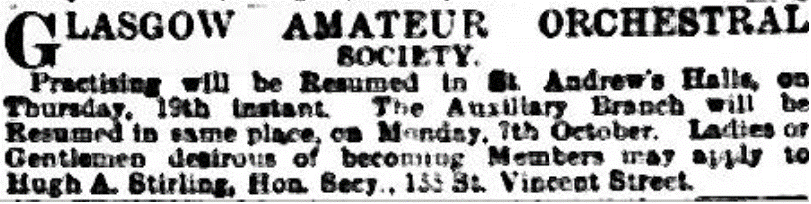
Forthcoming practice session printed in ‘The Glasgow Evening News’ , September 1889.
Below is a receipt dated 9th September 1889 for an advertisement in ‘The Glasgow Evening News’. The advert is a notification for the same practice session as discussed above. The payment amount was 10 shillings. The Glasgow Evening News was founded as ‘The Glasgow Evening Post’ in 1866. It was named ‘The Evening News’ from 1915 onwards. The newspaper ceased publishing in January 1957.
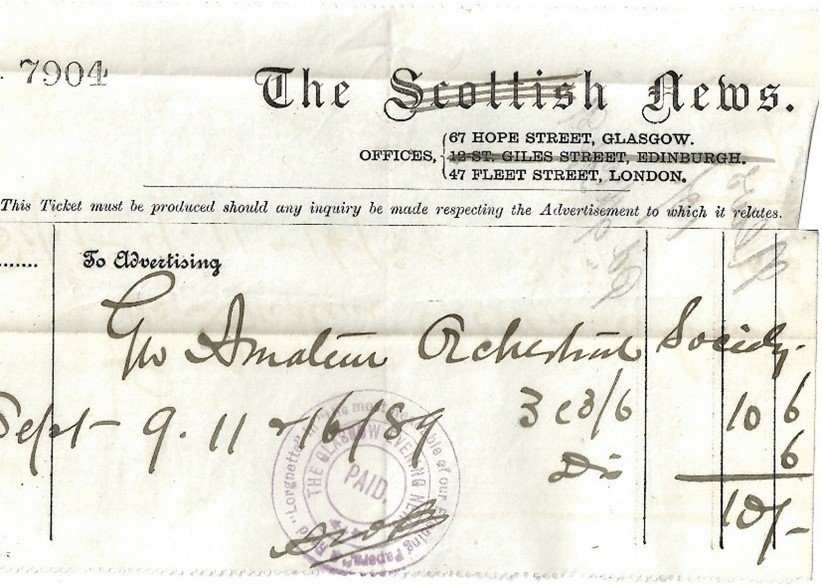
The advert, shown below, was published in the ‘Clydeside Echoes’ section on page four of the paper on the 12th of September 1889.

Forthcoming Concert printed in ‘The Evening Times’, April 1890
The receipt shown below is dated 11th of April 1890 and is for payment of 3 shillings and 4 pence to George Outram & Co for an advertisement in ‘The Evening Times’. George Outram and Co was the publisher and printer of ‘The Evening Times’, ‘The Glasgow Herald’, ‘The Bulletin’, and a number of weekly periodicals up until 1903 when it was incorporated as a limited liability company George Outram & Co Ltd which existed up until 2002. ‘The Evening Times’ and ‘The Glasgow Herald’ (now just ‘The Herald’) are still being published today by Newsquest Media Group Ltd. The Herald is the longest running national newspaper in the world.

The advertisement, shown below, appeared on the front page of the paper on Saturday the 12th of April 1890 in the ‘Entertainments’ section.

Forthcoming Concert and Review printed in ‘The Glasgow Evening News’, December 1893
Below is a letter dated 18th of December 1893 from the publishers of ‘The Glasgow Evening News’ in response to a letter from the Glasgow Amateur Orchestral Society informing the publishers of a forthcoming concert. The letter states where notification of the concert will be published and it also states that the newspaper will send a reporter to the concert.

Notification of the forthcoming concert, shown below, was indeed published in The Glasgow Evening News on the 18th of December 1893 in the ‘Local Musical Notes’ section on page 2.

A review of the concert, shown below, was published in page two of ‘The Glasgow Evening News’ on the 22nd of December 1893.

To see some of the documents of the invoice, or to learn more about the Glasgow Orchestral Society in the late Victorian age, visit us Monday to Friday from 10am to 5pm.
Tickets are free but booking is essential. Contact us at info@mbht.org.uk or 0141 948 0700.
Glasgow Orchestral Society exhibition: The Langfier Scandal
Words by Ruairi Hawthorne
*This topic has been researched as part of the Glasgow Orchestral Society exhibition.

Louis Langfier was a Polish photographer who operated in Glasgow, Edinburgh and London throughout the late 19th and early 20th centuries. While his date of birth is unknown, according to a 1901 census, he was living in London and was married to Pearl Langfier. He had two children: Eric and Iris who later claimed her father was a court appointed photographer. Indeed, his supposed list of clients is long and illustrious, from King George V to the King of Montenegro. However, despite his important place in history, very little is known about him, including his basic biographical dates of birth and immigration to Britain. It is only known that he came to Britain with his brother Adolf, whom he lived with for some time along with his family.
Langfier was a background player, always behind the camera, never in front of it. However, nearly 100 years after his death in 1925, it was uncovered through letters and journal entries that for a brief time, Louis was finally in the spotlight, at the centre of a scandal which he kicked off by simply taking the wrong photo of the wrong person.
The Glasgow Orchestral Society was founded in 1870 with the express purpose of bringing music and culture to their home city. The Society received praises but as amateurs they could never be fully appreciated by reviewers. They needed something to free them from the stigma of being amateurs and legitimize them as Glasgow's top orchestral society. Perhaps they decided that a professional photo could be just what they needed to overcome the negative perception of them as artless amateurs, and instead convey a sense of class and sophistication. And for that they sought best: Louis Langfier. To Langfier, this must have seemed like just another job in his long career. However, by accepting this job, he was indirectly starting a feud with the Orchestral Society, specifically one of its members.

Langfier’s invoice to GOS Director Mr Peacock, 1st July 1895
Officially, the Society hired Langfier to take a photograph of the group. In a letter displayed in the museum, the photographer details the nature of the commission, confirming the size in which the photograph will be printed and the type of plate in black and white. An invoice dated 1st July 1895 seals the transaction specifying the purchase of one group photograph at 7 shillings and 6 pence. However, through the letter of a Society’s member, it is understood that Langfier also took individual portraits of the amateur musicians during the session organised by the Society, but there’s no trail of documents in our possession testifying the organisation of these photographs. However, by reading what followed, it is clear that those would have been at the individual members’ expenses.
What is certain is that member Frederick Claasen was not satisfied with his portrait, saying he ‘‘hardly liked the twist in the mouth of one, and the posture of figure in the other’’ and demanded that Langfier send him another ‘retouched’ proof. However, in a separate letter to the Society’s director Mr Peacock, Claasen claimed Langfier never had his written consent to have that portrait taken and that he didn’t want it in the first place. According to the musician, the photographer demanded payment for the photo that he had already taken regardless, which Claasen refused. Due to Langfier’s insistence, Claasen attempted on multiple occasions to obtain the backing of the Society and have the matter resolved in front of the Society’s Committee, as mediators to the feud, but nothing came out of it.
Instead, after four unsuccessful attempts at delivery, Langfier resorted to legal action, having his lawyer contact Claasen on two separate occasions, each of which was ignored. It's unclear what would have happened if Claasen had continued to remain silent, however, the musician was enraged that his name could have been “dragged through the courts,” and insisted that this needed to be challenged with the full support of the Orchestral Society. He said it wouldn’t have been enough to just drop it after being twice ‘‘blackmailed’’ by Langfier. The displayed Claasen’s letter to the Orchestral Society was the last piece of documentation that we can find on the scandal, so to this day its outcome remains uncertain.
Was Langfier eventually granted his sought-after compensation, or did he decide to let the whole thing go? Was Claasen left to fend for himself, or did the Orchestral Society fight in his corner? Maybe one day the truth will come to light, but for now, we can only speculate. What we do know is that whatever the outcome of the dispute, it did not have any impact on Langfier’s career or the reputation of the Orchestral Society, proving perhaps that it was settled behind the scenes.
In the meantime, the Glasgow Orchestral Society went from strength to strength embracing their amateur status and refusing to cater to the unpleasable elite. Instead, they opted to stick to their strengths, breaching the confines of classical music and playing a variety of genres for a variety of audiences. To this day they are still dedicated to bringing escapism to the masses of Glasgow through the magic of music and I like to think that Langfier’s photograph, despite the minor conflict that it caused, played a small but significant part in getting them where they are today.
Unfortunately, this infamous photograph of the Orchestra was not in the Society’s archival collection. It is likely that the picture was one of the ‘casualties’ of the St Andrew’s Halls fire of 1962, that caused the loss of several instruments and material documenting the history of the Society.
Trivia
Between 1894 and 1898, Langfier’s studio was located in 202 Hope Street, just at the corner of Sauchiehall Street. He later moved to 137 Sauchiehall Street, not far from today’s Waterstones.
Some of Langfier’s pictures are kept at the V&A and National Portrait Gallery in London, including that of King George V and his wife Queen Mary.
According to the Glasgow Post Office directory of 1895, Frederick E. Claasen lived at 43 Dalhousie Street in Cowcaddens. He worked for Blackley, Young & Co, a company of merchants and agents based in 70 Wellington Street.
To see some of the documents of the scandal, to look at one of Langfier’s photographs from up close, or to learn more about Glasgow Orchestral Society, visit us Monday to Friday from 10am to 5pm.
Tickets are free but booking is essential. Contact us at info@mbht.org.uk or 0141 948 0700.

Langfier’s studio at 137 Sauchiehall Street, c.1910
Industry Along the Kelvin
Words by Ruth Currie
The Burgh of Maryhill grew up around the industry that developed along the Forth and Clyde Canal and its Glasgow Branch. But another waterway, the River Kelvin, flows through Maryhill.
Today there is a walkway from the Clyde right up the river through parks and woods and beyond the city. Indeed, you can continue linking up to the West Highland Way and walk the next hundred miles to Fort William. However, this was not always the case. The Kelvin was formerly the site for many industrial works making use of the river for about 200 years. Let’s take a walk along just part of the Kelvin and into Maryhill and look at some of the industrial sites and the bridges.
Kelvinbridge, Great Western Road

Kelvin Bridge, c.1825
The present bridge is the third bridge on this site built in the 19th century as Glasgow expanded West into Woodside, then Hillhead (another Burgh like Maryhill). Underneath the bridge, what is now part of the Walkway and the car park, used to be railway lines and coal yards. The line then crossed the river entering tunnels under the grand red stone tenement, the Caledonia Building, which towered above. This building was originally planned as a hotel by the railway company. The railway continued on through tunnels to Kirklee and on to Maryhill. The terminus is currently located under the Maryhill Shopping Centre.
Proceeding up the Kelvin as it enters the gorge, you can see the broken-down weir and some signs of former industries on the opposite bank, below the modern architects building. There are disused steps leading down to the river and a huge hole which carries the old Pinkston burn from the NE of the city - another area in which industry was rapidly expanding in during the 19th century.

North Woodside Mill, 1855
The North Woodside Flint Mill
After crossing the modern footbridge to the north-east side of the river, you will see the ruins of a flint mill on the old Gariochmill Rd. The mill ground flint from 1846 until after WW2 for use in Glasgow’s once extensive pottery industry. The original mill here was a mill to grind barley, in the days when the whole area was agricultural. Under the ownership of William Gillespie, at the beginning of the nineteenth century this switched to miling phosphate to produce alum which was then use in calico printing. The reason these mills were here was due to the water of the Kelvin flowing quickly through the gorge.
A little upstream is the magnificent weir which was built to hold the fast-flowing river back, allowing a controlled amount of water to be sent down the lade to the mill where it was used to drive machinery.
This whole area was eventually landscaped by Glasgow Corporation in the 1970s.So it is changed days with birdsong more noticeable than the sounds of industry.
Bridges

Walker’s Bridge on Queen Margaret Drive.
Just below the weir are the piers to a bridge which was known as Walkers Bridge after the man who had it built in 1870. It enabled the occupants of the new houses of North Kelvinside to have access to Great Western Road. It was demolished in 1971. The very impressive Queen Margaret Bridge nearby was opened in 1929. As you pass under this bridge and continue along the walkway, you are still on the route of the old Garriochmill Rd.
After passing the first of two bridges on the left, the walkway continues uphill on the right to join the now Garrioch Road. The first bridge leads into the Botanic Gardens which was built in 1890. Further on there is another bridge. This is not the original but a replacement for the Ford Road or Ha’penny bridge, built in 1886. It was built by the owner of Kirklee house who charged a ha’penny for people to cross. He didn’t want the people of Maryhill to ‘invade his land’! The toll house is still there where the money was collected.

Kirklee Bridge
If you cross this bridge into Ford Road then turn right and back down the road into what is now the Botanic Gardens Arboretum, you will pass under the magnificent Granite Kirklee Bridge which was built for people from the east side of the river to access the station at Kirklee. It is difficult to imagine that this arboretum was once an industrial site. Nineteenth century maps show it as the Kirklee bleachfields. Bleaching was an important part of the textile process. The cotton industry was one of Glasgow’s most important industries.
Crossing the river once again on the modern footbridge you cannot miss the railway bridge structures. These lines were not only for passengers to Maryhill but also for access to the various factories and works on both sides of the Kelvin. Up to the right is Wyndford and the site of the original army barracks.
Some industries

Kelvindale Paper Mill
One of the biggest and longest lasting of these local industries was the Kelvindale paper mill.
These were located immediately across the Kelvin by Kelvindale bridge at the foot of Kelvindale Road. Originally, the building was founded in the 18th Century as a snuff mill. Snuff was ground tobacco which was sniffed rather than smoked. From 1840 the large complex became a paper mill, belonging to Edward Collins & Son. The site was ideal as a lot of water is used in the manufacturing of paper. Like many other industries, the business finally closed in the 1970s. A few of the workers’ houses remain. The site is now utilised by private housing.
A little further up the river there is a dramatic V- shaped weir. Water from here went through a lade to the works.
Before continuing under the canal, notice the pier in the middle of the river. This is now a roost for cormorants.

Dawsholm Gas Works
Passing under the dramatic aqueduct carrying the canal, there are the remnants of yet another railway bridge that crossed the Kelvin. Soon after, is the modern road bridge at the foot of Cowal Street where modern houses have been built. This was the site of Dawsholm gas works, an enormous complex, bounded by the canal, the Kelvin and railway lines. Gas made from coal in the 19th and 20th century was first used to light both streets and houses. Gradually it took over from coal to be the main means of cooking and heating in the home. Electricity became the main form of lighting. Gas works existed in all towns and cities during that period. The pungent and stifling smell from the works will be remembered by people of older generations. In the 1970s gasworks became redundant as North Sea and other natural gas replaced coal gas. Two gas holders or gasometers still exist by Temple Rd. These were designed to store gas and would go up and down depending on how much was being held before distribution.
This post has only mentioned a few of the works that have come and gone along the Kelvin. Long before there was any industry, the river’s water was used to drive the mills that ground the corn grown on nearby farms. It was the same force of water which could be used to drive machinery before the days of steam power and also to provide the large quantities of water used in the cotton and other industries. But that has changed.
There is no industry left along the river. Instead, it has reverted to what it must have been like hundreds of years ago. The polluted waters of the old industries have gone. The clean waters now have fish in them again. Birds once more populate the banks. You can often see a heron just standing waiting for its next meal from the water. Cormorants too know they will get a meal. Other small birds live on the banks. Occasionally a kingfisher can be seen darting along. People can again just enjoy the river for what it is. But the remaining signs of industry can tell a story of Maryhill’s recent history.
(As I write this in January 2021, the banks of the Kelvin are not so peaceful. Huge works are being undertaken to improve the old Victorian sewage system. But once this is finished the river will be even cleaner.)
All pictures have been taken from Urquhart, G. R., ‘‘Along Great Western Road: An Illustrated History of Glasgow’s West End’’, Stenlake Publishing, 2000.
Welcome to the Maryhill Burgh Halls Blog
Here you will find in-depth research and snippets into our local history which has been conducted by volunteers, staff and friends of the Halls.