Maryhill 1856
Words by John Thomson
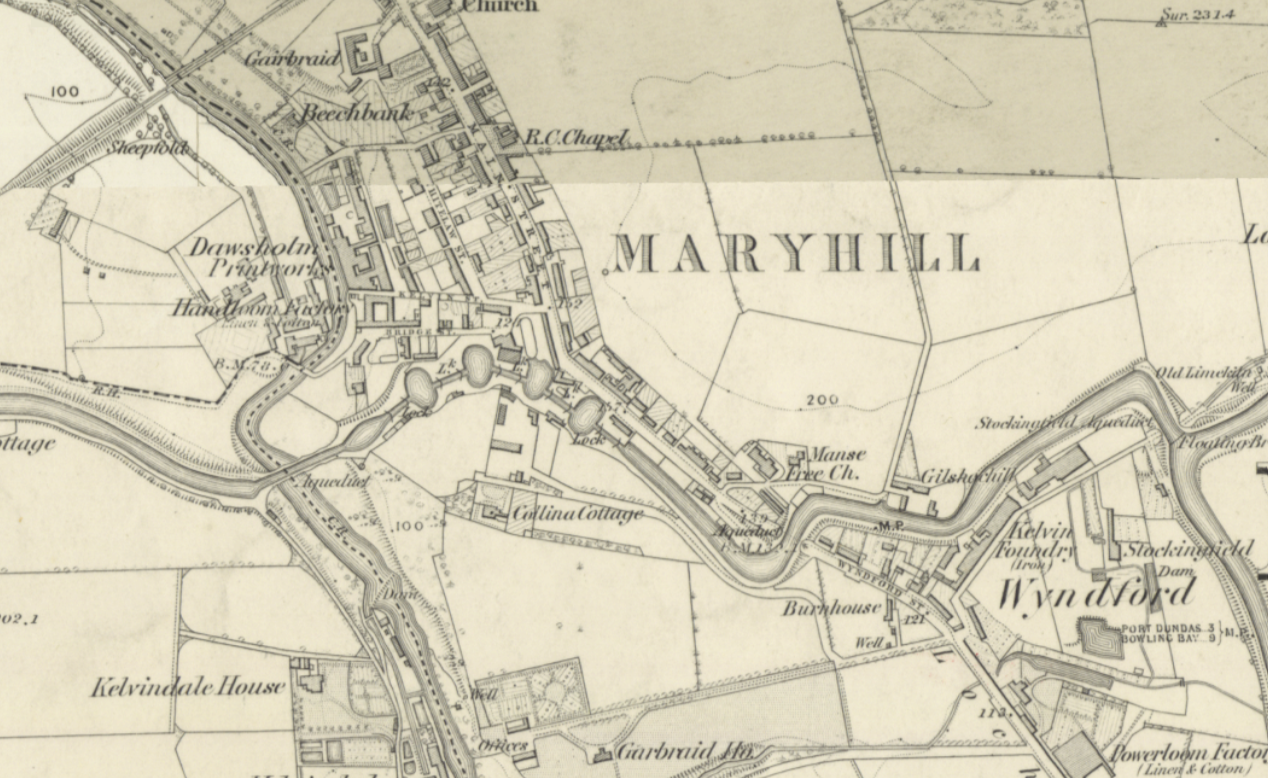
Maryhill Map, circa 1856-1880 (NLS)
By 1856, Maryhill was already a bustling township – although much of the housing was spread out over the old Gairbraid, and adjacent, estates. Its three thousand inhabitants were gainfully employed in a number of trades, some of which had preceded the arrival of the Forth and Clyde Canal in 1790.
Papermaking, for example, had been in the area since 1690 and calico printing was also well established, but the biggest influence was the opening of the canal which saw boatbuilding, sawmills and iron founding come to Maryhill.
One sign of the influence of boatbuilding in the area was the creation of a large graving (or dry) dock which became known as the Dry Dock, the Dock or Kelvin Dock, giving its name, briefly, to the area but also to a well known pub, which, sadly, is no longer with us. The dock was used for ship repair.
Evidence of all these trades can be seen in the stained glass windows in Maryhill Burgh Halls – either in their original form in the Main Hall or in replica form on the Heritage Wall across from the Maryhill Hub café.
The first tenant of the Dry Dock was Thomas Morrison but it was taken over by David Swan who had married Morrison’s daughter. He added shipbuilding to the business and went on to become Maryhill’s first Provost.
Swan was described as an ambitious man, who was later to become the driving force in the creation of the new burgh of Maryhill in 1856. Amongst the ships he built were several schooners which regularly made the journey to Australia for several years – not ‘clydebuilt’ but ‘Maryhill built.’
But it was not just these canal-related trades that added to the expansion of Maryhill. The 1850s saw the construction of the Glasgow, Dumbarton and Helensburgh Railway with the addition of a local railway station soon after, which further connected Maryhill’s goods and workers to the region, and the beginning of work in the area to lay pipes for supplying the city of Glasgow with water from Loch Katrine – a supply which continues to this day.
More workmen were required and many of ‘these temporary inhabitants were lodgers, and before long some of them were associated with the more turbulent residents in raising “Cain” (as Americans phrase it) in the streets and thoroughfares of the place. The absence of street lamps made it all the more risky to any person walking, especially along what is now Main Street to escape being assaulted in some form or another…………A number of the inhabitants after quietly discussing the matter, resolved that this state of disorderly rowdyism should be stamped out, and law and order maintained in the place.’ (Alexander Thomson)
A petition was signed by the required number of local people and it was presented to the Sheriff of Lanarkshire, who put through the necessary legislation to make Maryhill a Police Burgh in 1856.
One of the first appointments was George Anderson as Superintendent of Police and Fiscal, and the first Provost was the shipbuilder, David Swan, who was a powerhouse in bringing the various elements of the township together as a modern burgh.
Anderson was originally from Brechin and was known as ‘the Captain’ and he supervised the move into the new police station at the corner of Maryhill Road and Fingal Street. It not only provided space for a court and magistrate’s chambers, but also accommodation for the officers.
‘A coat of arms was designed in the form of a shield with a representation of the aqueduct with a ship on top and symbols of engineering, (iron)founding and sawmilling beneath, and the motto ‘Vires acquirit eundo.’ (Aileen Smart). And it translates as "We gather strength as we go"
In 1878, with the continued expansion of the burgh of Maryhill, more public buildings came into being to reflect its growing status, with the planning, and building, of the Burgh Halls in the French municipal style being a centrepiece to the continued development of Maryhill. The architect was Duncan McNaughton.
Of course, as mentioned earlier, one of the main features was the creation of twenty stained glass windows representing many of the trades and professions that have been part of the Maryhill story. Following the refurbishment of the Halls a few years ago, there are still eleven of the original windows, and the Halls, themselves, continue to play a leading role in the life of Maryhill, a very proud burgh.
Sources:
‘Villages of Glasgow’ vol 1 by Aileen Smart, John Donald Publishers 1988,
‘Random Notes and Rambling Recollections of Drydock, the Dock, or Kelvindock. Now known by the Modern Name of Maryhill. 1750-1895’ by Alexander Thomson, Leopold Classic Library (no date),
and the wisdom of previous writers for the Maryhill Burgh Halls Blog.
