Words by John Thomson
‘THE PRESENT STATE of the canal leaves much to be desired. Disuse by boats has resulted in parts of the canal becoming a rubbish-filled derelict eyesore.’ (The New Glasgow Society, in the sixties)
and
‘Throughout the sixties and early seventies the “Killer Canal” headlines were reinforced by the political assurances that the canal would be filled in as soon as money was available’. (Richard Davies, 1985)
Recently (late summer of 2026), Maryhill Burgh Halls mounted an exhibition called ‘Every Picture Tells A Story’, based on a painting by Andrew MacLaren Law. The painting reflected how busy the canal was in 1879 and how much there was to see in that one snapshot (as it were) of a busy waterway. The exhibits and the stories on the walls of the wee museum room reflected that story, prompting, as these exhibitions tend to do, memories of a time past and, maybe, of members of the family who gained their living from working on, and around, the canal.
But the organization, Scottish Canals, also played a major part in the exhibition and used the exhibition space offered by the walls of the staircase leading to the upper foyer area to good effect. They brought people up to date with current plans for the canal, including what was happening to the aqueduct site. They also displayed some historical pictures of the refurbishment of the canal back in the seventies and it was these that Richard Davies himself was looking at when I bumped into him and introduced myself as a Burgh Halls volunteer.
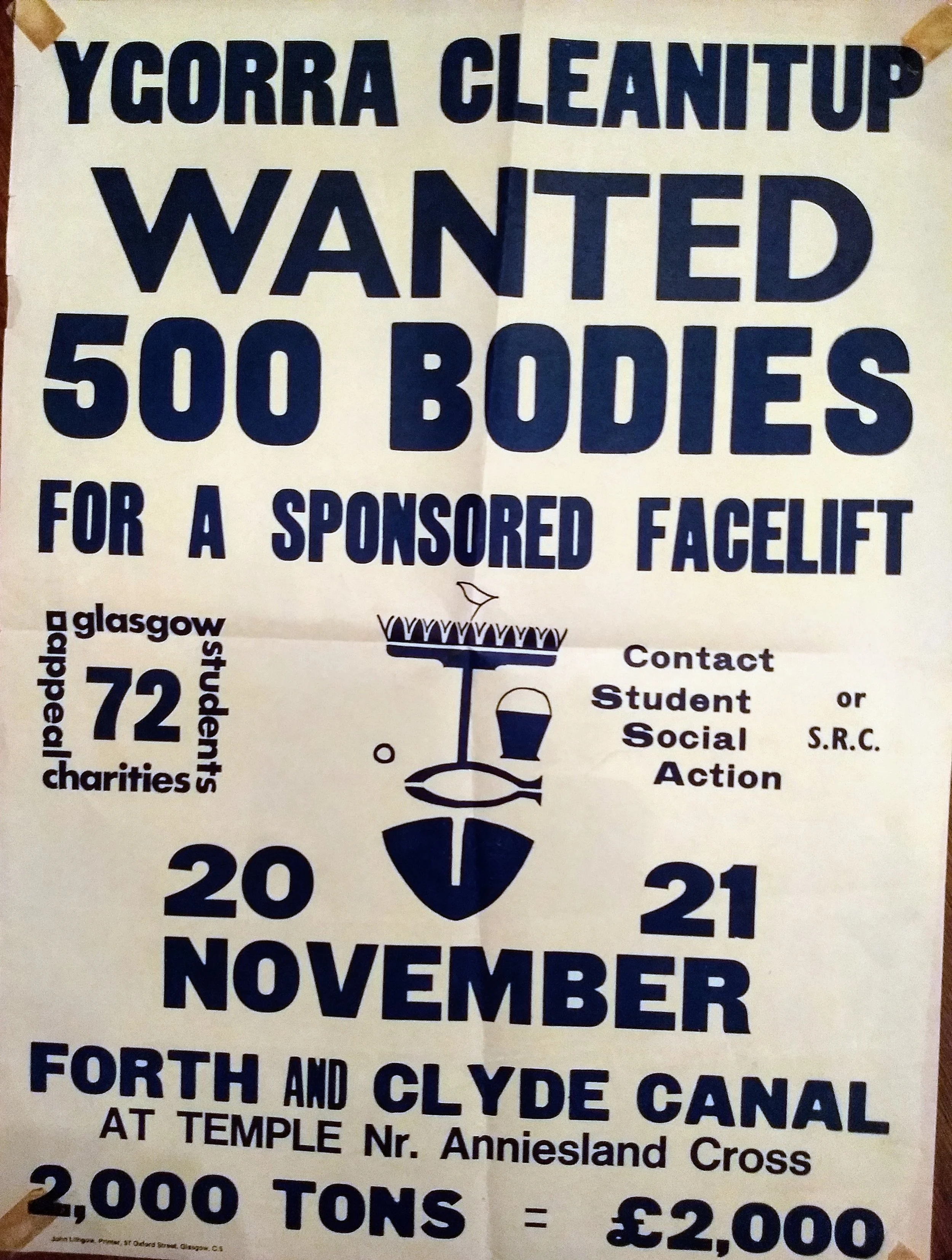
In fact, he was standing in front of a poster from 1971 calling for 500 bodies for a sponsored facelift of the Forth and Clyde Canal at Temple, near Anniesland Cross, the canal having been closed on 1st January 1963. (In those days, Glasgow Uni students prefixed every charity appeal with ‘Ygorra’ and this was no exception. Repeat, loudly, after me: ‘Ygorra Cleanitup’).
I’ll let Richard take up the tale.
‘Before coming to Glasgow in 1968 as a student (Naval Architecture), I had cruised a fair bit of the English canal network and had spent many dirty weekends restoring derelict canals down there. So, I was used to canal refurbishment but the Forth and Clyde Canal posed a significant challenge, and no-one had any idea of the enormity of the task.
‘Through the Glasgow Students’ Charities Appeal we launched a sponsored clean up at Temple and Maryhill. That was the start of a slippery slope into campaigning for the complete restoration of the canal – which culminated in the Millennium Link re-opening in 2001.’
And, yes, that weekend, in true Taggart style, they did find a couple of guns and a car, and the obligatory supermarket trollies and assorted other rubbish.
‘But it was about winning the hearts and minds of the locals and convincing them that it was more than some loony student project.’
And Richard tells a tale of a meeting in Clydebank when the Bankies had to be convinced of that. A potentially difficult meeting down Kilbowie way was defused by a well known journalist and broadcaster of the time, Cliff Hanley, whose magic way with words maybe didn’t leave them ‘dancing in the streets’ but it did convince them of the benefits of the canal, although fish and chips being sold on a canal boat was an idea whose time was yet to come.
But what part, I wondered, did the Burgh Halls play in all of this? A pretty basic one, it turns out.
‘I first remember the Burgh Halls complex when, in 1975, I organised a visit of volunteers from the south to assist in clearing out the top lock chamber to see if the structure was sound enough to allow future re-opening of the canal. Our volunteers were invited to use the baths afterwards – I hope the vast amount of mud didn’t clog up the drains!’
The public baths and wash house which opened in 1898, are now part of the Glasgow Club. At one point, they included thirty-six wash-stalls, two washing machines, a seventy-five foot long swimming pool, twenty-five private baths for men, but only six private baths for women (This is My Glasgow).
‘A few years later, probably early 1980s, when I was working for Glasgow District Council, I was asked to see what help might be given to a small group of people wanting to save the Burgh Halls. By that time, even the baths had closed and the building looked beyond saving.
‘The question was controversial at the time but the local elected member, Bob Gray, was very supportive and we were able to make some grant aid available for material to support a Job Creation scheme to renovate some parts of the building. As far as I can remember, they got one room set up as a recording studio, set up a small business in the yard – recycling pallets or something like that – and then attempted to get the main hall reopened.’
But, forty years on, what, I wondered, did Richard make of the Burgh Halls of 2026?
‘Wow, what a difference from the semi-derelict building I remember. The place is full of people and activities; there is light where before it was dark and gloomy. There are lots of new parts of the building seamlessly integrated into the old one.
‘It’s a good example of how urban regeneration projects such as the Maryhill Corridor can kick-start a long process of renewal as it’s not just the Burgh Halls but the whole area that seems to be buzzing. It’s also good to see the canal getting some attention again, and, hopefully, it will become busy again when the current repair works are complete.’
And that’s something we’re all looking forward to; when the current work on the Kelvin Aqueduct is done and we can maybe get canal traffic flowing all the way through to Bowling. In the meantime, it was a pleasure to talk to Richard and to share his memories, but that’s what we do as volunteers – help people to share memories and to add to our own knowledge. There were six hundred visitors to the exhibition – each of whom went away with an appreciation of the canal and its importance to Maryhill.
After all, Maryhill heritage is as much about those memories as it is about bricks and mortar. Richard was smashing to talk to but so, too, was the man, I met, whose cousin in Canada is the great-great-grand-daughter of the artist himself, and the woman who was baptised in the church featured in the painting – chance encounters that helped to bring life to a painting of one view of the canal.
Every picture does indeed tell a story.
