
Words by James Boyd
“That’s my childhood you’re talking about” was Lynne Ramsey’s retort to being told that she was just another posh person making a film about the working-class experience. The Maryhill-born director, who has been described by Martin Scorsese as “the most extraordinary filmmaker”, is probably best known for her 2011 feature We Need to Talk About Kevin; however, it is her 1999 debut Ratcatcher where the Maryhill influence is most obvious.
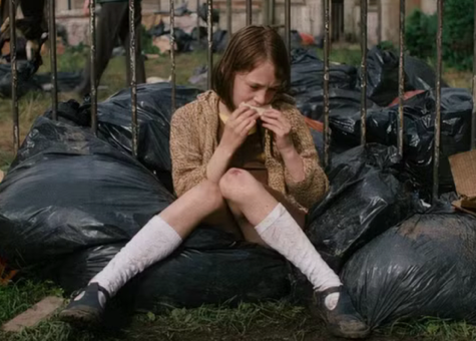
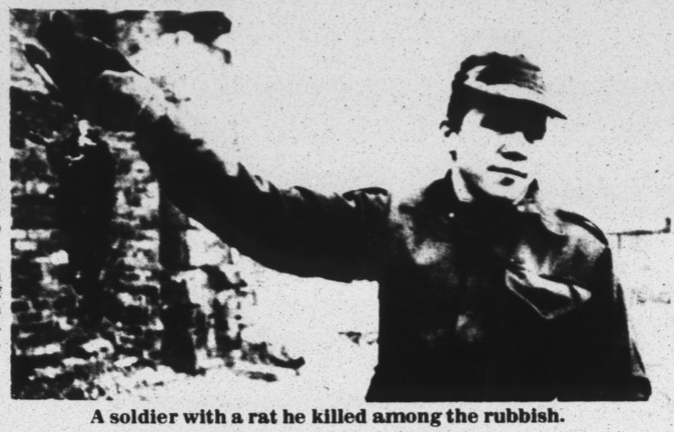
Ratcatcher follows James, a young boy navigating childhood during the 1973 dustmen’s strike, with the piled-up bags of rubbish providing a constant backdrop for the film’s events. Throughout Ratcatcher, kids are seen playing amongst binbags, James’ sister eats a sandwich sat on a mountain of rubbish, and, following the death of James' friend Ryan, the hearse door struggles to open due to the streets being lined with them. Ramsay’s Maryhill influence is evident in all of this. Having moved from Maryhill to Summerston at the age of 5, she remembers the strike as “a lot of fun”, and has said that by portraying the strike from a child’s point of view she was able “to go from brutality to beauty”. Although the adults treat the rubbish as disgusting, the children find joy in wading through the rubbish and hitting the bags with sticks in the hope of catching a rat. On one occasion, Kenny, another young boy, lifts up a dead rat, in a parallel to the famous picture of a soldier proudly displaying his catch, accompanied by the headline “The Ratcatcher”.
Ramsay describes the canal as an “ugly-beautiful” place that she was fascinated by, finding it to be both “seductive and dangerous”. The canal becomes the centrepiece of the film’s most impactful moments, opening with James accidentally killing Ryan whilst they play together in the canal, then his father rescuing Kenny, and finally with James drowning himself, falling deeper as the end credits roll. In keeping with the pollution portrayed, Ramsay was forced to use a canal set due to the real thing being too contaminated.
Although Ramsay has spoken about having a happy childhood, James’ desire to move to the new housing mirrors the move to the newly built Summerston that Ramsay’s family did make. Just as a young Ramsay marvelled at the two toilets and a bath her home now contained, James is enamoured with the standards of the houses. The cleanliness offers a clear contrast to the state of his current situation: a bath with running water as opposed to the tub we see his younger sister get checked for lice in. When James gets on the bus, the camera focuses on the extent of the rubbish he passes. After he leaves, he kicks a solitary can down the otherwise empty path. The refuge James finds in what he hopes will be his new surroundings makes it all the more crushing when he is blamed by his father for their failure to get the move. Ramsay notes that James’ destiny is written into the harshness of his surroundings.
Alongside the content of Ratcatcher, Maryhill would influence Ramsay’s style as a filmmaker. Initially wanting to be a painter, Ramsay discovered photography at a visual arts centre for underprivileged kids in what she described as a ‘‘shitty part of Maryhill”, where young people could hone their craft with a view to attending art school. This background in photography would do not just open the door for Ramsay to attend art school and later a dedicated film school, but would also carry through into how she crafts her characters, aiming to visualise a “three-dimensional picture of a person”. At both the start and end of Ratcatcher, James adjusts his mother’s stockings to cover up a hole that she’d been trying to fix to no avail. For Ramsay, this was an expression of James’ love boiled down to one gesture, finding the emotion in something seemingly mundane.
The dustmen’s strikes provide a backdrop for the film’s events, but they aren’t the main concern. The photographic records used, along with Ramsay’s own memories, form the starting point, but Ramsay focuses on the visual opportunities offered by the setting rather than delving into the history. With childrenat the heart of the story, Ramsay for the most part avoids the political questions raised by the strike. As the soldiers arrive, there is a short shouting match between neighbours from their windows, but otherwise the conflicting views on the strikes being broken are neglected by Ramsay. Part of the reason for this is that Ramsey draws inspiration from both the 1973 and 1975 dustmen’s strikes. Ratcatcher is explicitly set in 1973; however, the imagery of the piled-up rubbish and the deployment of soldiers are more commonly associated with the 1975 strike.
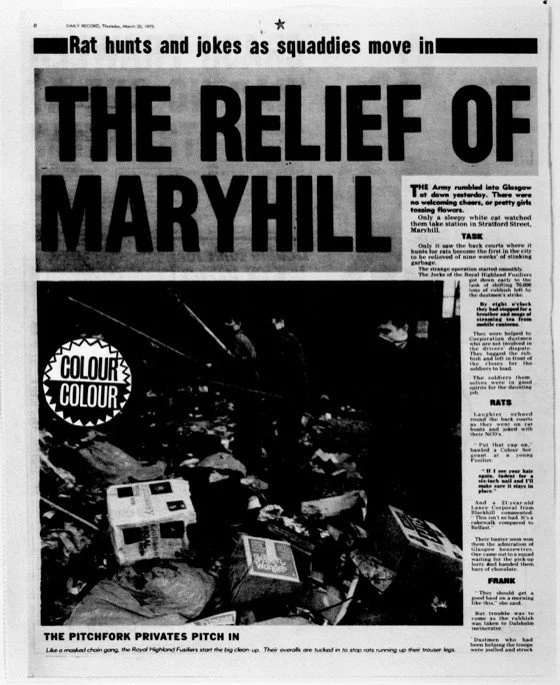
One of Ratcatcher’s few other references to the politics of the strikes comes from a news report of the period, with the anti-striker messaging apparent. The deployment of 1,500 troops in Glasgow in 1975 was the first time that the military had been used in an industrial dispute in 25 years. By this point, the conditions were as bad as those depicted in the film, yet news channels covering the strike have since been criticised for their refusal to give a voice to those undertaking industrial action. Newspapers from the time give a similar message, with the Herald reporting that women waved from tenement windows and passers-by on their way to work were keen to give soldiers the thumbs up. The headline in the Daily Record read “THE RELIEF OF MARYHILL”. So, whilst Ramsey may not have wanted to deal with the politics of the strikes in Ratcatcher, by including even just that one news report, she highlights a crucial aspect of how the population of Maryhill lived through the strikes.
The effects of the strike on James’ life are significant, but once the soldiers are brought in and the rubbish is gone, his ‘‘destiny’’ doesn’t change. He is still living in poverty, he still has to watch his friend Margaret being taken advantage of by older boys, and he still has to live with what happened to Ryan Quinn. Whilst Ramsay is careful to include more tender moments, Ratcatcher is a film that shows the grim reality of life for many in Maryhill at the time, a perspective made possible by her own upbringing.
Sources:
- David Trotter- Lynne Ramsay’s Ratcatcher: Towards a Theory of Haptic Narrative
- Tina Kendall- ‘The in-between of things’: intermediality in Ratcatcher
- Alex Law, Jan Law- Magical Urbanism: Walter Benjamin and Utopian Realism in the film Ratcatcher
- Nitrate Online: Ratcatcher- Interview with Lynne Ramsay- by Paula Nechak
- Thegentlewoman: Lynne Ramsay, by Mark Smith
- Filmmaking Lifestyle- Lynne Ramsay
- Bafta: The Journey- Lynne Ramsay interview
- Lynne Ramsay interviewed by Danny Leigh- BFI London Film Festival 2025
- Amy Duffy- Glasgow Live: Glasgow’s Rubbish Strikes of 1975 That Kicked on a Stink for 13 Weeks
